-
The brake shoe comparison: Centric Parts 111.04620 vs. the cheapest set in the catalog
-
Centric brake rotors vs. budget rotors: new is not a specification
-
Open element air filter vs. the factory air box: not the win most buyers expect
-
What is an exhaust manifold? Cast iron vs. steel tube
-
Fuel pump location: the hidden cost no parts comparison shows
-
Which option should you order?
When I first started buying brake parts for the shop, I assumed the lowest quote was the only number that mattered. That assumption died between a brake comeback and a spreadsheet line I still remember.
I run purchasing for an 8-person independent repair shop in the Midwest. Over six years, I've analyzed roughly $180,000 in brake and undercar spending, negotiated with a dozen suppliers, and tracked every warranty comeback in the same cost sheet. The pattern is consistent: the cheapest part is rarely the cheapest part.
This article walks through that pattern using the parts buyers ask about most: Centric brake shoes, Centric brake rotors, open element air filters, exhaust manifolds, and fuel pump location. The comparison standard isn't invoice price. It's total cost, meaning purchase price plus labor, downtime, and the probability of doing the job twice.
The brake shoe comparison: Centric Parts 111.04620 vs. the cheapest set in the catalog
Anyone can sell you a brake shoe. Few can tell you what is actually inside the box before you open it. Drum brakes are old technology, but comebacks from badly matched shoes are an expensive new problem.
When I pull up the Centric Parts 111.04620 brake shoe in our distributor catalog, I get application data, shoe width, lining material, and a hardware list. A budget equivalent often shows one word: fits. That is not a specification.
To be fair, not every budget set is trouble. In 2023, I bought 12 budget shoe sets for a quarterly order to save $18 per axle over Centric. Nine sets were perfectly fine. Three generated customer complaints within a week, noise on light braking, then grabbing. We spent about four hours diagnosing and redoing that work at a $110 shop rate, plus two replacement sets. The $216 I saved on paper turned into roughly $540 of real cost.
Why does this happen? Cheaper shoes sometimes use less consistent friction material, and the information gap hides it. You don't find out until the customer does. If your shop warranties labor, a 25% problem rate is catastrophic. I don't care how attractive the price looks; no data means no quote from me.
Centric brake rotors vs. budget rotors: new is not a specification
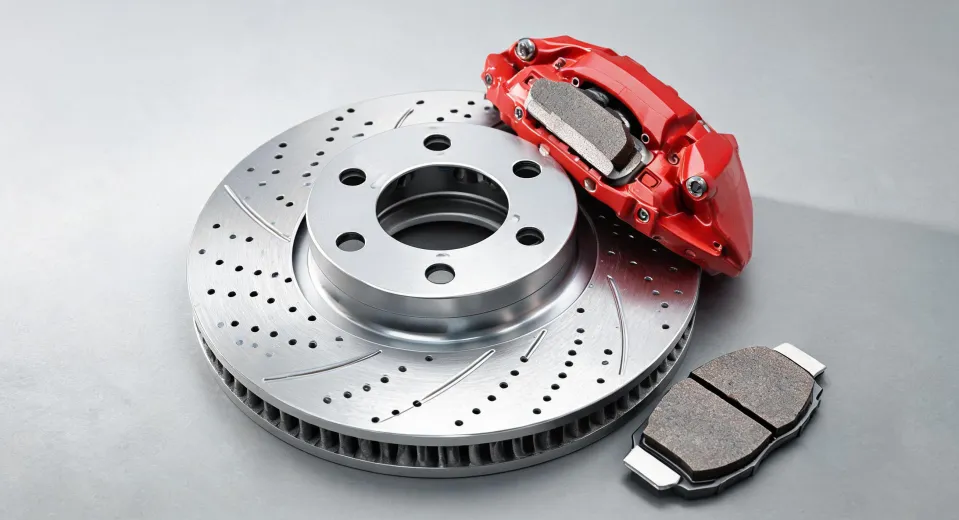
A rotor is a rotor is the sentence that costs shops money. The metallurgy and the machining tolerances are what determine whether a rotor stops smoothly and stays that way.
Centric brake rotors are not the cheapest option on our shelf. A budget rotor can be $30 less. But when we order cheap, we have caught rotors out of the box with lateral runout beyond spec. Not enough to see. Enough to feel as pedal pulsation at highway speed. A new part that is out of spec is not a part; it's a diagnosis project.
The last budget rotor we installed cost us nearly two hours of diagnostic time. It looked perfect. No blue spots, no cracks, no obvious defect. The technician finally measured it and found thickness variation. We swapped in a Centric rotor, same pads, same calipers, same day, and the pulsation disappeared.
That is why I now check runout and minimum thickness on every rotor order. Centric publishes those specs. A supplier who can't or won't share them is going to cost you more than the price difference between rotors.
Open element air filter vs. the factory air box: not the win most buyers expect
An open element air filter replaces the enclosed factory air box with an exposed conical filter mounted directly to the throttle body or mass air flow housing. It looks like a performance upgrade. Sometimes it is. Often it isn't.
Everything I'd read said more airflow means more power. In practice, most stock engines cannot use all that airflow, and an open filter in the engine bay inhales air that has already passed over the radiator. At highway speed there is enough flow. In stop-and-go traffic, intake temperatures climb, the engine pulls timing, and the upgrade becomes a downgrade.
I get why people want them. They look good and make an engine sound like it's breathing. But for a daily-driven vehicle without a tune or dyno numbers, the factory air box is usually the lower total cost. An oiled cone filter can also foul a mass air flow sensor if over-oiled. A $400 intake plus a $180 MAF sensor isn't a performance mod. It's a bill.
Where does an open element filter make sense? Track cars, some hot rods, and tuned forced-induction builds with a properly sealed inlet. For a stock street car, skip it and spend the money on brake parts that actually matter.
One more warning: if a listing claims high-flow, eco-friendly, or 50-state legal without a flow test or a CARB executive order number, treat it as a red flag. Per FTC advertising guidance, objective claims need substantiation. A vendor who can't show data is selling adjectives.
What is an exhaust manifold? Cast iron vs. steel tube
Let's answer the basic question first: what is an exhaust manifold? The exhaust manifold is the metal component bolted to the cylinder head that collects exhaust from each cylinder and routes it into one outlet. On V engines, there is one manifold for each bank.
Two designs dominate replacements: one-piece cast iron manifolds, which are the OE style, and tubular stainless aftermarket manifolds, often called headers.
Cast iron manifolds retain heat, resist corrosion, fit predictably, and don't crack under normal heat cycles. Tubular manifolds are lighter and can create better exhaust scavenging at high rpm, but they use thin flanges and welds. On a street vehicle driven daily, that is where the hidden cost shows up.
In Q2 2024, we replaced a cracked manifold on a work truck. A previous shop had installed a budget tubular manifold, and it cracked near the number three runner after 18 months. The owner saved about $160 in parts at installation. The redo, with gaskets, studs, and labor, came to roughly $700.
For most fleet and daily-driven vehicles, an OE-style cast manifold is the lowest total cost. A quality tubular manifold makes sense only when the engine is tuned for it and the vehicle's use actually justifies high-rpm gains. That is an exception, not a rule.
Fuel pump location: the hidden cost no parts comparison shows
Sometimes the smartest comparison isn't between two parts. It's between two locations. Fuel pump location is the best example I know.
On some cars, the pump sits under the rear seat, accessible through a small hatch. On other models, it's on top of the fuel tank, and the tank has to be lowered. On some trucks, the bed has to come off. The pump itself can cost the same $180. The labor difference can be $600.
The first time I approved a fuel pump replacement by comparing pump prices alone, our actual labor ran 3.4 hours over the estimate. That became a customer credit and a lesson. Now, before any fuel system quote, I check fuel pump location for the exact year, make, and model. It takes two minutes and saves more than any coupon code.
Looking back, I should have built that step into our estimating process on day one. At the time, I trusted book time. Book time is fine when the pump's location matches the book's assumption. It doesn't always.
Which option should you order?
If someone tells you to always buy premium parts, they've never managed a budget. If someone tells you to buy the cheapest parts every time, they've never managed a comeback.
- Choose Centric brake shoes and Centric brake rotors, or any supplier willing to publish friction data, runout limits, hardware lists, and material specs, when the vehicle will stay in service for years and you warranty the labor. That is where total cost favors the better part.
- Consider budget parts only when the vehicle is headed to auction or a short-term sale, and only if the basic specs are actually published. Those cases exist, but they are rare.
- For induction, keep the factory air box on daily drivers. Install an open element air filter only when the build was designed and tuned around it.
- For exhaust, make an OE-style cast manifold the default. Choose a tubular manifold when the engine is built for it, not because stainless steel looks good in an engine bay.
My procurement spreadsheet doesn't have a column for pride. It has a column for total cost. The extra money for Centric Parts 111.04620 brake shoes and Centric brake rotors has come back to me in shorter brake jobs, fewer comebacks, and customers who don't return with pulsation complaints. That is what transparent pricing and transparent specifications actually buy.