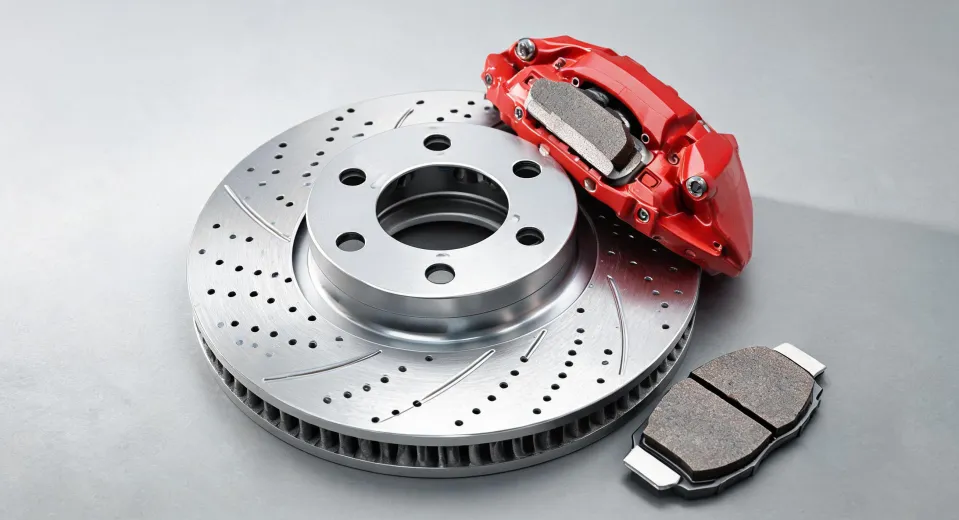
Four wheels came back to the counter last Tuesday. The customer said they vibrated at 70 mph, and every shop he'd tried told him the wheels were defective.
They weren't. All four balanced perfectly. Road force numbers were within spec. The problem wasn't the wheels—it was the space around the hub. The wheels had a generic 73.1 mm center bore, and the car's hub measured 66.1 mm. Without hub centric rings for aftermarket wheels, the wheel is centered by the lug nuts instead of the hub flange. This one sat just off enough to shake.
The fix was a $15 set of rings. We offered them at the time of ordering. The customer declined.
Before I sound too confident, I should admit that I made the same mistake in 2018. I've handled parts orders for eleven years, and I keep a log of my own significant mistakes. There are 23 entries so far. The total cost sits somewhere around $16,000 in return freight, restocking fees, and labor that had to be redone. Most of those parts were not defective. They fit. That was the problem.
The $15 Ring Nobody Believes In
A hub has a machined register—the raised lip that centers the wheel before the lug nuts are tightened. Most factory wheels are hub-centric: the center hole matches the register closely, and the wheel is located precisely. The lug nuts clamp. They don't have to center the wheel.
Aftermarket wheels are different. Many are cast with a common 73.1 mm center bore so one wheel style can fit several brands. If your hub is smaller, hub centric rings for aftermarket wheels bridge the gap. They look too simple to matter. Sometimes a lug-centric mount works anyway, and sometimes it doesn't. It depends on tolerances and a bit of luck.
My 2018 mistake had no excuse. I ordered wheels with a 73.1 mm bore for a car with a 64.1 mm hub. I carried a set of rings to the counter, then put them back because I decided the tapered lug nuts would center the wheel. It was fine in the city. At 70 mph, the car vibrated like a cheap hotel fan.
The first shop rebalanced the tires and handed the keys back. The second shop measured the hub, explained the ring gap, and charged me for the diagnosis. The total came to about $140—for a $15 part I had already decided to skip. A balance machine spins the tire and wheel as one assembly. It cannot see the gap between wheel and hub once the wheel is installed. The system had to be inspected, not the part.
Brake Shoes That Fit—and Still Got Blamed
Brake shoe returns are the closest thing we have to a recurring dream. The shop orders shoes by application, installs them, and the brake pedal sits too low. The shoe gets blamed.
Often, the shoe was never the problem. New shoes are thicker than worn ones. If the adjuster is not backed off to get the drum on and then expanded to set the running clearance, the wheel cylinder has to push too far before the shoe contacts the drum. The extra fluid has to go somewhere, so it goes into the pedal.
Last spring, a shop returned a Centric parts 111.08510 brake shoe and said the brake pedal was nearly to the floor. The shoes were correct. The technician had backed the adjuster off to install the drum and never set it again. When we set the adjuster properly, the pedal was firm. The product was fine. The procedure was incomplete.
Before ordering any brake shoe set, it is worth asking about drum condition and the adjuster's state. A new shoe on an out-of-round or worn-out drum will not fix the braking system. A shoe can only be as good as the surface it presses against.
The “Plug-and-Play” Lie
“Plug-and-play” usually means “the connector matches.” It does not mean the electrical system agrees with what you just plugged in.
I learned this on a motorcycle. I installed a Harley LED turn signal set and got hyperflash. Every turn blinked like a warning sign. I swapped in a second set from a different brand and got the same result. It wasn't the bulb twice in a row. It was the circuit. The flasher expected the current draw of a filament bulb. The LED drew so little current that the flasher read it as a burned-out bulb and sped up.
The fix depends on the vehicle: an LED-compatible flasher, a load resistor, or module programming. But if I had started with the electrical system, I would never have returned the first set.
Headlights follow the same pattern. A 9005XS LED headlight bulb can fit its socket and still not work with the housing. The bulb has to put its light source where the filament originally sat. The cooling collar has to clear the dust cap. If the cap can't close, the assembly is no longer sealed, and moisture follows. Those are system checks, not socket checks.
Why Is My Cooling Fan So Loud in My Car?
This is a real question we get, word for word: “Why is my cooling fan so loud in my car?” My first answer after eleven years is another question: when is it loud?
An electric cooling fan is loud because it's spinning fast. It is often working. The fan speed follows coolant temperature and air-conditioning pressure. If the engine is running hotter than it should, the fan will be loud. Replacing it with a new fan doesn't change the logic that commanded it.
The return that finally taught me this came from a vehicle with a slow coolant leak. The engine got hotter than normal, and the fan stepped up to high speed at the end of every trip. To the driver, the noise sounded like a fan failure. He replaced the fan assembly with a good one. The noise did not change. A pressure test found the radiator leaking. After the cooling system was repaired, the fan ran at normal speed again. The symptom was real. The component wasn't the cause.
When people hear noise, they want to replace the noisemaker. But a cooling fan on high is often an effect. Start with temperature, coolant level, thermostat, and air-conditioning pressures. If you replace first, you often replace a part that was doing its job downstream of an actual fault.
The Pattern It Took Me Too Long to See
After 23 logged mistakes, the pattern became visible: I was testing each part as an object. But an installed part isn't a solo object. The wheel bolts to a hub. The brake shoe presses against a drum. The LED bulb interacts with a flasher, a housing, and a lens. The cooling fan responds to the cooling system. Compatibility is a relationship, not a catalog line.
When a new part doesn't solve the problem, the first question should not be “What's wrong with this part?” It should be “What part of the system did I not check?” That shift changed how I handle every order now.
The Checklist That Finally Stopped the Bleeding
After entry number 23, I typed out a checklist and put it next to the phone. It looks deliberately too simple. That's the point.
- Measure or inspect the thing the part interacts with. Before brake shoes, measure the drum's inside diameter and look for ridges or uneven wear. A Centric parts 111.08510 brake shoe is only correct when the drum and hardware side of the system are ready.
- When wheels are involved, ask what centers them. Compare the wheel's center bore to the vehicle's hub register. If aftermarket wheels use a larger center bore, hub centric rings for aftermarket wheels are not an upsell. They restore the original mounting geometry.
- Confirm the electrical system can handle the new load. An LED bulb has a different current draw than a filament bulb. A Harley LED turn signal may need an LED-compatible flasher or load resistor. A 9005XS LED headlight bulb may need housing clearance and optical compatibility checks before installation.
- If a part makes noise, ask what would make it do that. For a loud cooling fan, check coolant level, thermostat behavior, and whether the noise changes when the air conditioning is turned off. The answer to “why is my cooling fan so loud in my car” is often found before the fan is removed, not after.
- Log the symptom after the replacement. If the exact same symptom remains, the part was probably never the source. That note will save you from repeating the mistake next month.
Nothing on this checklist is expensive. That's what makes it irritating. It asks for five minutes of verification in a world that wants a part number and an answer.
A correct part in the wrong system isn't a solution. It's just an expensive clue. The goal is to inspect the system before you order the part. Everything after that is easier.