I'm a procurement manager at a 140-person fleet maintenance company. I've managed our parts budget ($420,000 annually) for 7 years, negotiated with 60+ vendors, and documented every order in our cost tracking system. When people ask me whether to buy Centric rotors and pads, cross an FL2127 oil filter, pick a Coleman CT200U spark plug, or replace a cooling fan, my first answer is usually: it depends. Not a cop-out. The wrong part in the wrong scenario costs more than the right part bought at a premium.
Here's how I break it down. Three things: application, duty cycle, and total cost. In that order.
First, classify your situation
Most parts decisions fall into one of four buckets. If you're not sure which bucket you're in, don't buy yet.
- Daily driver / light fleet: commuting, deliveries, normal stop-and-go. You care about fit, noise, dust, and predictable wear.
- Heavy-duty / towing / performance: heat soak, repeated hard stops, high gross vehicle weight. You care about thermal capacity, thickness, and pad compound.
- Small-engine equipment: Coleman CT200U-style mini bikes, generators, pressure washers. You care about exact plug reach, heat range, and gap.
- Cooling system repair: overheating at idle, AC weak in traffic, fan not spinning. You need diagnosis before parts.
Scenario A: Daily driver / light fleet brake job
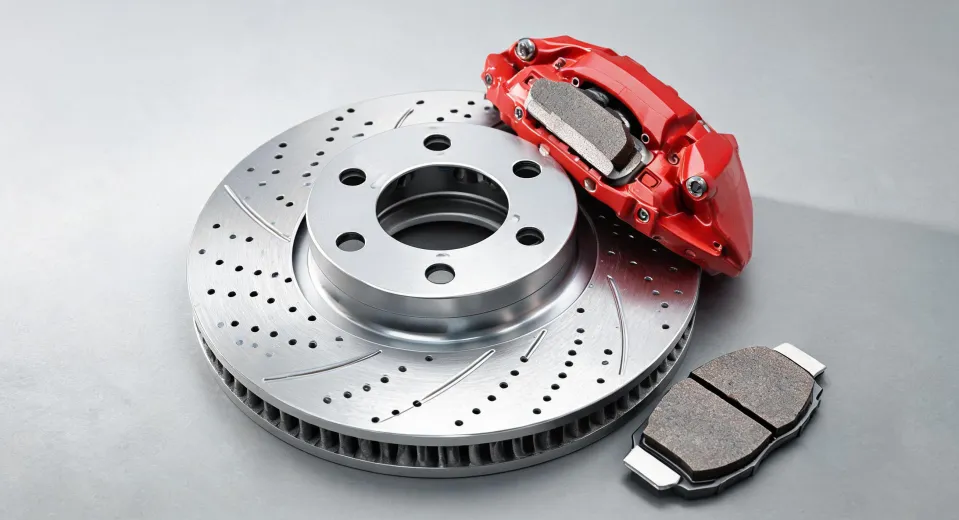
For this scenario, Centric rotors and pads are usually a sensible OE-replacement choice. Centric's catalog covers a huge range of vehicles, and its coated rotors help with rust in salt-belt states. According to Centric's official catalog (centricparts.com), you should match by VIN or exact trim, not just by year/make/model.
What I track in my TCO spreadsheet: rotor pair price, pad set price, hardware kit, shipping, and labor. The lowest-priced rotor often loses when you add a separate hardware kit or when the coating fails in two winters. Centric rotors and pads usually bundle well and come with the small clips and shims more often than the bargain bin.
Honest limitation: this is not a track setup. If you're doing repeated 100-to-0 stops, move to Scenario B.
Scenario B: Centric vs Raybestos rotors for heavy-duty use
Centric vs Raybestos rotors is not a brand-wide answer. Both companies make multiple grades. Compare the actual part number, not the logo on the box. Look at:
- Rotor thickness and weight
- Vane design (straight vs directional)
- Coating type
- Pad compound match
- Warranty terms and return shipping
For a half-ton pickup doing occasional towing, Centric rotors and pads can be fine. For a fleet of loaded trucks in mountain terrain, I'd price Raybestos' higher-tier rotors against Centric's premium line and check brake fade data from the manufacturer (raybestos.com; centricparts.com). I can only speak to our route profiles. If you're running hotshot loads or police-style duty cycles, the calculus might be different.
What I don't do: assume the more expensive rotor is automatically better. I've seen a premium rotor fail the same way as a mid-grade one when the calipers were dragging. Fix the root cause first.
Scenario C: FL2127 oil filter and Coleman CT200U spark plug
The FL2127 oil filter is a specific filter number, often cartridge-style in late-model Ford/Lincoln applications. It is not universal. The expensive mistake is buying by thread or diameter when the engine uses a cartridge with a specific bypass valve, O-ring, and end cap. Use a VIN-based lookup or the OEM application guide (motorcraft.com). According to filter manufacturer catalogs, the FL2127 number should be confirmed against the engine code, not just the model year.
For the Coleman CT200U spark plug, most CT200U manuals list a BPR6ES-style plug. I'd verify the gap—commonly around 0.028–0.031 in (0.7–0.8 mm)—in your specific owner's manual because Chinese-built small engines sometimes change suppliers mid-year. If the plug is black and sooty, don't just replace it. Check the air filter and carburetor. A $4 plug won't fix a rich condition.
There's something satisfying about a small-engine tune-up that actually fixes the hard-start issue. After chasing a no-start on a CT200U for a week, I found the plug was fine and the real problem was old fuel. That's the kind of thing that doesn't show up in a parts catalog.
Scenario D: What is a cooling fan, and when do you replace it?
A cooling fan moves air across the radiator and condenser. Electric fans usually kick on when coolant temperature reaches a set point or when the AC is on. Mechanical fans run off the engine belt or a fan clutch.
If your vehicle overheats at idle but cools down on the highway, the fan is a prime suspect. If it overheats at highway speed, the fan is less likely—airflow is already high. Check the fan relay, coolant temp sensor, and wiring before buying a fan assembly. I've seen a $30 relay misdiagnosed as a $280 fan module. That one still stings.
For fleet buying, I keep a rule: diagnose first, then price the fan. Aftermarket fan assemblies vary wildly in connector quality and shroud fit. A cheap fan that pulls less CFM can cause repeat comebacks.
How to know which scenario you're in
Ask four questions:
- What is the duty cycle? Commuting, towing, racing, or small-engine equipment?
- What is the failure mode? Wear, heat, contamination, or electrical?
- What is the cost of a comeback? If labor is $150/hour, saving $20 on a part is a bad trade.
- Can you verify the part number by VIN, engine code, or OEM manual?
If you answered daily driver and wear, Centric rotors and pads are probably enough. If you answered heavy-duty and heat, compare Centric vs Raybestos rotors by specific grade and cooling data. If you answered small engine, get the exact Coleman CT200U spark plug and gap. If you answered overheating at idle, test the cooling fan circuit before replacing the fan. If you answered FL2127 oil filter, verify the cartridge spec—not just the number someone quoted online.
No universal answer. But you can usually avoid the expensive one.
Prices and part numbers change. Verify current pricing and fitment with the manufacturer or a VIN-based lookup before ordering. This is general guidance, not a substitute for a repair manual.