Here's the bottom line: if you're buying brake parts for a fleet or a customer car, the cheapest rotor is rarely the cheapest repair. And if you're looking at white smoke from the exhaust and muffler area on a car that's losing coolant, spend $30 on a combustion leak test before you order anything. A bad head gasket can look exactly like an exhaust leak, and a $600 muffler will not fix a blown gasket. I've watched this happen more times than I care to count.
Now, why should you listen to me? I'm a procurement manager at a 40-person aftermarket parts distributor. I've managed a purchasing budget of maybe $1.8 million a year for nine years—maybe $1.6 million once we added the warehouse, I'd have to check the P&L. I've written POs for brake rotors, brake shoes, filters, exhaust parts, and enough gasket sets to fill a shed. I don't claim mechanic-level diagnosis. But when the warranty returns pile up, I'm the one who sees the pattern.
Brake Rotors: What the Cost Sheet Actually Shows
Most buyers focus on the price of the rotor and completely miss the cost of a comeback. This is the part of the catalog that hurts.
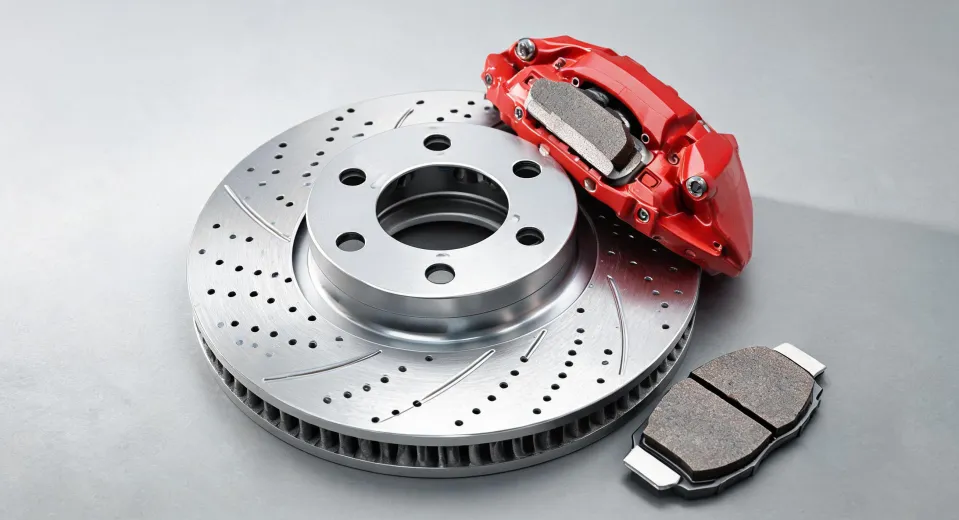
For a daily-driven street car, the Centric premium OE style drilled brake rotor is my standard recommendation in the online catalog. It's not a track-day part. It's an OE-style rotor with a drilled pattern. That gives the look and some help with heat and water dispersion for street use, but I don't pretend it's the same as a big-brake racing rotor.
Here's the procurement math. For a 40-piece order, we compared a budget blank rotor at $12.80 each against the Centric rotors at $21.40 each. By part number, the budget rotor looked like a 40% savings. But the pivot table from our cost tracking system said the budget rotor actually cost us $31.70 per unit after two warranty comebacks, one billing dispute, and a labor write-off. That's not a typo. The cheap rotor cost more than the premium one after the hidden costs showed up. Source: our procurement system, Q2 2024.
That doesn't mean every Centric part is always worth the premium. For a one-time brake job on a car that will be scrapped in a year, the cheapest safe rotor might be fine. But if you're billing the work or warranting it, hidden costs are the whole game. At least, that's been my experience in aftermarket distribution.
Brake Shoes and the Parts Around Them
For drum brake work, we stock Centric 111.04460 Centric brake shoes. It's an OE-style shoe set we order for selected light truck applications. The shoe itself is usually fine. The bigger point is what happens around the shoe: springs, adjusters, hardware. I can't count the number of times a return came back and the actual problem was old hardware. The new shoe cost was never the issue.
The Same Logic Applies to a Whirlpool Air Filter
Yes, I just talked about brake shoes, and now I'm talking about a Whirlpool air filter. Stick with me. In appliance parts, the same trap exists: a customer brings in a part number for a Whirlpool air filter, sees a non-OEM filter at half the price, and buys it. If the cheap filter doesn't seal against the filter housing, unfiltered air carries dust around it. The blower motor or compressor sees a heavier load. That's when the repair costs can exceed the appliance's residual value.
From a buyer's perspective, the question isn't 'is this filter compatible?' It's 'does this filter seal the same way?' Compatibility just means it fits in the box.
How to Tell If You Have a Bad Head Gasket
Now to the diagnostic problem that costs more money than any single part. A lot of people first notice a head gasket problem when they see white smoke from the exhaust and muffler area. The smoke can look like steam, and there may be a sweet coolant smell. The natural thought is 'the muffler is bad.' Stop there.
Here's how to tell if you have a bad head gasket, in the order I'd run the checks:
- Check the coolant reservoir when the engine is cold. If it's low and you can't see a leak, that's a red flag.
- Let the engine idle for a few minutes. If the coolant level rises and bubbles while idling, combustion gas may be pushing into the cooling system.
- Look at the oil dipstick and the oil fill cap. A milky tan color on the dipstick is a stronger sign than under the cap, but neither is proof by itself.
- Use a combustion leak test kit. This is a $30 to $40 bottle of blue fluid and a tube that sits on the radiator neck. If the fluid turns yellow/green, exhaust gas is in the coolant. That is the closest thing to a simple answer you can get without teardown.
I'm not a mechanic, so I'm not going to tell you how to rebuild a cylinder head. From a purchasing perspective, the test is the decision point. A positive combustion leak test means the car needs a reputable engine repair shop, not a muffler shop. I don't have hard data on how many head gaskets get misdiagnosed as exhaust failures, but from our return logs, it happens at least a few times a year.
One more thing: a cracked cylinder head can produce the same test result. A head gasket test won't tell you where the failure is; it tells you there's a failure. The next step is a compression test or a borescope. That's not a product pitch. It's the difference between fixing a car and gambling on a part.
What I'd Do Differently
Looking back, I should have tightened our vendor approval process earlier. For the first few years, I trusted 'fits similar to OE' in catalog descriptions. Then a bad batch of filters cost us a service contract. And another thing I'd change: I'd have pushed for standardized return codes on every warranty part. Without those codes, you can't calculate your own total cost per SKU. You're just guessing.
Here are the three cost-control rules we've built since then:
- Test before you buy. If a symptom could be a bad head gasket, exhaust, or muffler, test the cooling system. The test is $30. The wrong part is $600 plus labor.
- Compare total cost, not box price. Add returns, comebacks, and time. If you haven't tracked those, you don't know what anything actually costs.
- Ask what the part includes. Some rotors come with hardware and some don't. Some brake shoe sets include springs and some don't. The missing hardware isn't an upgrade—it's a hidden purchase order.
When These Rules Don't Apply
If you're working on your own car and you enjoy it, ignore most of what I said. You're not running a business; your time is free, and a comeback is just an afternoon in the garage. Also, if it's a dedicated race car, you may want a rotor designed specifically for heat and repeated stress—not an OE-style drilled rotor. And if the customer has been quoted a full engine repair for a car that's worth $2,000, the right financial decision may be to stop. A $30 test protects you from wasting money, but it doesn't make a 250,000-mile engine a sound investment.
The last exception: if the cylinder head itself is cracked, a new head gasket won't fix it. The test tells you there's a problem, and a good machine shop tells you which one. Don't let anyone sell you a head gasket as a cure-all until the heads have been measured. That's the honest limit of what a parts buyer can say.