I handle parts sourcing for a small independent shop. Eight years in, and I've personally made — and documented — 14 significant mistakes, totaling roughly $12,000 in wasted budget. The one I'm about to describe still stings.
The Job That Should Have Been Easy
Customer rolls in with a Honda Crosstour. Wants a full refresh: new brake rotors and pads up front, brake shoes in the rear, fresh bulbs, a radiator replacement, and a set of wider wheels with spacers for stance. Big order, but ordinary. The spec list included the Centric Premium OE Style drilled brake rotor, Centric 111.07951 brake shoes for the back, D5S headlight bulbs, a Honda Crosstour radiator, and generic 20mm wheel spacers. I ordered everything in one afternoon.
Two days later, the phone rang. Pedal pulsation at highway speed. Vibration through the steering wheel. My first thought? Warped rotors. Maybe the customer bedded them in wrong. Maybe a caliper was sticking.
Classic wrong answer.
The Real Problem: What Are Hub Centric Wheel Spacers?
The vibration wasn't the rotors. It was how the wheels were sitting on the car. Full stop.
Here's the bit most people skip: your wheel is not centered by the lug nuts. The center bore of the wheel — the big hole in the middle — fits over the hub flange on the vehicle. That flange does the centering. The lug nuts hold everything in place, but the hub flange is what puts it in the right place.
Now add spacers into the stack. A proper hub centric wheel spacer has a hub bore on the vehicle side that matches your hub flange, and a center bore on the wheel side that matches your wheel. The centering job transfers seamlessly from the hub, through the spacer, to the wheel.
What did I order? A flat plate with holes. Lug-centric. The wheel was being centered by the cone seats on the lug nuts — by friction and optimism. That works for about five minutes. Then the wheel shifts a few thousandths, runout appears, and every brake rotor in that corner becomes a witness to the vibration.
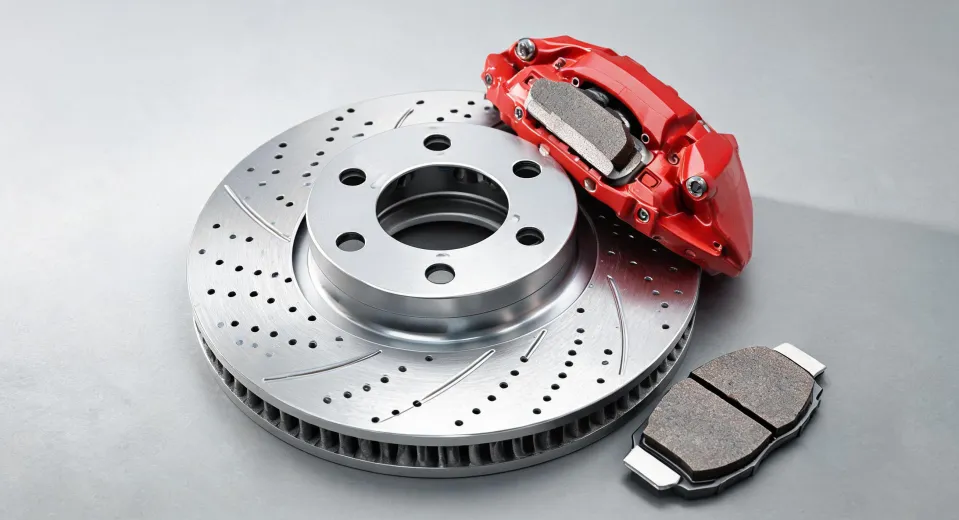
Here's the deeper issue I had to own: the drilled rotors made it worse. The Centric Premium OE Style drilled rotor is a fine piece of machining. But drilled rotors have a purpose. They shed gas between pad and rotor under high track temperatures. On a daily-driven Crosstour, those holes are stress risers that crack over time and create uneven pad deposition. The solid OE-style version of the same rotor is the honest recommendation for 90% of street cars. I knew this. I ordered the drilled ones anyway because the customer liked the look.
So now we had a lug-centric spacer introducing runout, plus a drilled rotor amplifying the consequences of uneven contact. The rear brake shoes — Centric 111.07951 — were correct. I verified that one. The bulbs were correct. The radiator was correct. All the "real" parts were right. The failure came from the generic hardware I treated as an afterthought.
Why does this matter to you? Because if you're pricing out a job like this, the spacer is the cheapest line item on the invoice. Easiest thing to overlook. And it's the one that sends a perfectly good brake job back into the shop.
The Actual Price of the Mistake
Let me put real numbers on it, because that's how I learned (this happened back in September 2024, and the invoice still haunts me):
- Spacers, scrapped and replaced with hub-centric ones: $160 wasted.
- Labor to pull the drilled rotors, reinstall, then repeat with the solid rotors: $240 of my time that I couldn't bill.
- Two days of bay occupancy instead of the promised one-day turnaround: roughly $300 in lost jobs.
- Customer trust: priceless, and damaged.
That's $700 and a week of goodwill, gone because I didn't spend 30 seconds checking the hub bore specification. The Crosstour's hub is 64.1mm. The spacer I bought didn't even list a bore spec. I still kick myself when I think about it. The information was right there in the catalog — I just didn't look.
The pattern is everywhere. People order spacers and drilled rotors as a "package deal" without understanding how the two interact. The runout from a lug-centric spacer creates uneven rotor wear. The drilled rotor accelerates that unevenness around the holes. Hot spots, pulsation, complaints, and a part that gets blamed even though it did exactly what physics dictated.
I can only speak to my context — small shop, B2C jobs, mostly Asian-market vehicles. If you're a fleet buyer doing high-volume work, your tolerance for this might be different. But the geometry isn't. A wheel that's centered by lugs alone will vibrate. Period.
The Checklist I Use Now
If I could redo that Crosstour job, this is what I'd run through before ordering. It's now the checklist I maintain for our whole team:
- Know the hub bore. Every vehicle has one. The Crosstour uses 64.1mm. Look it up before you order anything that sits between the hub and the wheel.
- Check both sides of a spacer. A hub centric wheel spacer must specify its vehicle-side bore and wheel-side bore. If the listing doesn't say both, it's not hub centric.
- Match rotor design to actual driving. Track use? Drilled is defensible. Street daily? The Centric Premium OE-style solid rotor gives you full pad contact, less noise, and no stress risers.
- Verify part numbers in writing. The Centric 111.07951 rear shoes fit the Crosstour correctly — I know because I checked. Checking is the whole job. The mistake that cost me $700 wasn't the part I verified; it was the part I assumed.
And if someone asks me whether they should run spacers at all? Most street-driven vehicles don't need them. If the offset is genuinely wrong, hub-centric spacers at least keep the geometry honest. If the offset is fine, skip the spacers and save yourself the failure point. Same logic applies to the drilled rotor: it works great in the right context, but "looks cool" isn't a spec.
The rest of that job had a happy ending — the D5S bulbs worked from day one, and the Honda Crosstour radiator went in without a fight. But those were the easy parts. The $700 lesson came from the $60 piece of metal I didn't respect.
That's the thing about understanding what hub centric wheel spacers are. They're the difference between your wheel being located by engineered surfaces or by friction. One keeps the brake rotor running true. The other gives you a pulsation that sends a perfectly good brake job back to the shop.
I've got the receipts to prove it.