Sometimes you get one phone call and it defines your week: a Range Rover Evoque overheating with coolant on the floor, a frayed serpentine belt that's 200 miles from home, and a catalytic converter quote that doesn't make sense. I'm the person who coordinates urgent parts orders for repair shops—12 years, 200+ rush orders. Here's what I tell drivers when they need a straight answer.
If you're in a hurry, here's the menu:
- Are Centric brake pads good?
- What does the Centric Premium high-carbon alloy rotor actually do?
- Range Rover Evoque cylinder head—how bad is this repair?
- Frayed serpentine belt—can I still drive?
- How much for a new catalytic converter?
- Why does part quality matter for your shop's reputation?
Are Centric Brake Pads Good?
Yes—but 'Centric' is a brand with more than one tier. You can buy their economy line or their better performance-oriented line, and the difference matters.
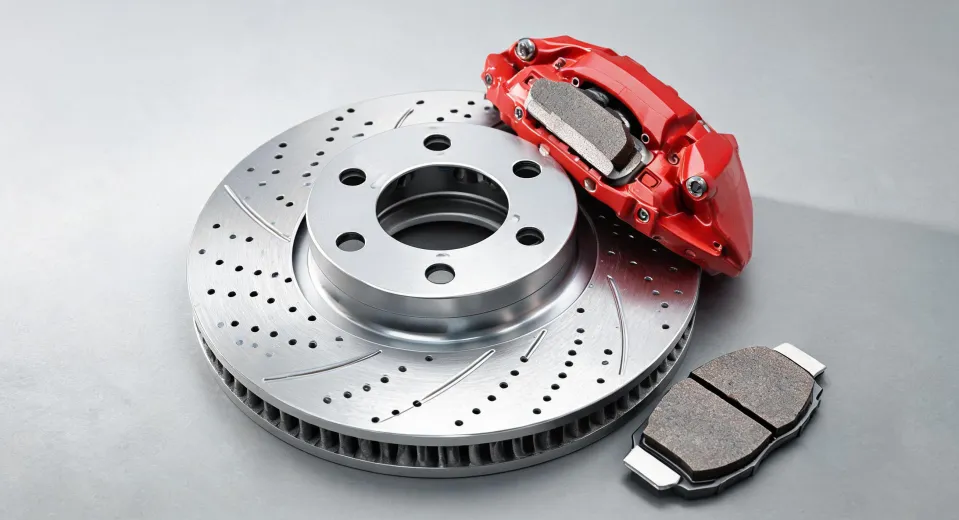
What I mean is that 'good' depends on which part you're talking about. Their standard pads are solid OEM replacements. Their premium pads are the ones I spec when a customer complains about brake dust, noise, or fade. When I compared a cheap-house pad against a Centric pad side by side on the bench, the Centric had a uniform friction material, no exposed rust on the backing plate, and a chamfered edge that reduces squeal. The cheap one looked like it had been cut with a box cutter.
I've installed Centric pads on customer cars and on my own. They're not exotic, but they're predictable. In this business, predictable beats mysterious every time.
What Does the Centric Premium High-Carbon Alloy Brake Rotor Actually Do?
The short version: it handles heat better. A 'high-carbon alloy' rotor has a slightly different metallurgy than a standard blank rotor. More carbon in the iron means it holds up to repeated hard stops without developing hardness spots or 'warping' as quickly. What you get, in practical terms, is less pedal pulsation over the rotor's life.
I'll be honest—I used to think rotors were rotors. Then I compared a cheap rotor and a Centric Premium high-carbon rotor on the same car after 10,000 miles. The cheap one had a heat pattern you could feel with your fingertip. The Centric was still glassy smooth. (That's the kind of thing you don't notice until you've had a customer come back with a vibration complaint you can't explain.)
It's not the cheapest option, and it's not the 'heaviest duty' tracking rotor either. It's the right middle answer for a daily driver that needs to stop confidently.
Range Rover Evoque Cylinder Head—How Bad Is This Repair?
It can be bad. On some Evoque engines, the cylinder head can crack around the exhaust ports or develop a warped deck after an overheating event. The classic clues are coolant disappearing without an obvious leak, white smoke from the exhaust, or oil in the coolant. If you ignore it, a head crack can turn into a hydrolocked engine or a bottom-end failure—and that's a much bigger invoice.
I remember a customer who called us after a local shop said 'maybe it's just a thermostat.' They drove another week, lost more coolant, then needed a full engine. The 'wait and see' decision cost them three times what a pressure test and early diagnosis would have cost. It was the textbook save-a-dollar-pay-a-ton moment.
A proper Evoque cylinder head replacement involves the head, gaskets, bolts, labor, often coolant and oil, sometimes a timing chain set while it's all apart. Depending on the engine and whether you use OEM or a quality aftermarket casting, you're generally looking at $3,000 to $6,000+ at a specialist. I went back and forth with one client between OEM and a cheaper aftermarket head for two days. We chose OEM because the labor was already the big cost, and a $600 saving wasn't worth the risk of redoing it all.
Frayed Serpentine Belt—Can I Still Drive?
Honestly? If it's frayed, no. A serpentine belt doesn't fail gradually in a convenient place. It can have a few cracked ribs one day, and the next day the cords let go at 70 mph. When it snaps, you lose the alternator, power steering, and in many cars the water pump. That turns a $40 belt and a 45-minute job into a tow bill, coolant loss, or an overheated engine.
Frayed belts show up in our shop more than they should. People notice a little fuzzy edge or a tiny crack and say 'it's probably fine.' I get it—you don't want to be stranded, and a belt doesn't feel urgent like a brake pad. But this is one of those cheap fixes that can become expensive fast.
In March 2024, a fleet van came in 36 hours before a deadline with a frayed belt that had visible cord. We sourced a quality replacement belt and a tensioner (because a worn tensioner is usually what started the fraying), did the work in one visit, and the van made the trip. The customer still sends us business because we didn't shrug and say 'it'll probably last.'
How Much for a New Catalytic Converter?
According to RepairPal's national repair estimates (accessed January 2025), expect around $800 to $2,500 for most vehicles, including parts and labor. A Range Rover Evoque can run higher—think $1,500 to $3,500+—because the converter is specific to the engine program and labor time includes the heat shields and sensors that often need to be replaced too. The converter itself might be $300 to $900 for an aftermarket unit, but your total includes gaskets, oxygen sensors, and the shop's time.
Before you decide, three things:
- If the converter is clogged, find out why. A failing catalyst is usually a symptom of a rich condition, coolant in the exhaust, or a misfire. Fix the cause first, or you'll be replacing the new converter in six months.
- Budget converters exist, but they're a gamble. If the check engine light comes back with a P0420 code a week after install, you haven't saved anything.
- Get the quote in writing. Legitimate shops don't need to 'sell' the converter with mystery fees.
That's for a proper replacement, not a 'cheapest cat on the internet' special. In this case, the quality of the part directly affects whether you get a clean inspection and a quiet exhaust.
Why Does Part Quality Matter for Your Shop's Reputation?
Because the customer isn't buying a part—they're buying a decision. When you approve a repair, your shop's name goes on the invoice. A cheap rotor that vibrates in three weeks isn't just a part failure; it's a phone call you have to answer, a slot in your service bay you have to re-open, and a customer who now halfway trusts you.
Early in my career, I made the classic mistake of approving a low-cost cylinder head without checking the machine shop's quality. The head came back with a hairline crack after the first heat cycle. It cost us freight, re-labor, and a chunk of trust. That's why I now look at the total cost, not just the unit price—and why I'd rather recommend a solid middle-tier part like a Centric brake pad or a well-known rotor than fight a warranty claim on a mystery brand.
When I compared our comeback rate on economy parts versus better-quality parts over a full year, the cheap parts didn't save us money—they cost us more in rework and customer goodwill. The $50 difference per brake job translated into customers who didn't call three weeks later. That's the kind of data you don't get from a spec sheet.