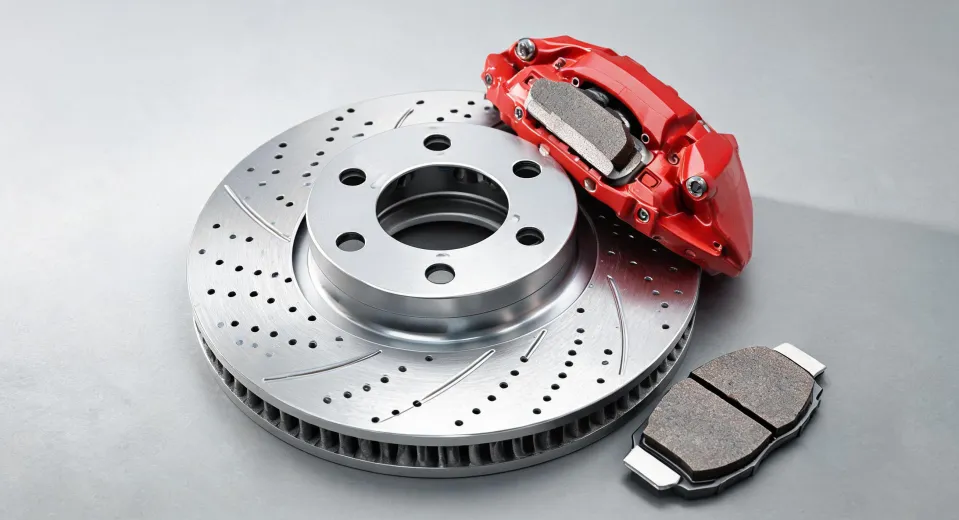
"Are Centric Brake Rotors Good?" — The Question I Get Every Week
Are Centric brake rotors good? I get asked this at least twice a week — usually by a DIYer loading a cart or a shop owner tired of comebacks. My answer is always some version of: "It depends."
That's not me being vague. Centric is a genuinely solid manufacturer — one of the more consistent rotor brands in the aftermarket. But "good" isn't just a property of the rotor. It's a match between the part and your situation. A blank rotor that's perfect for a 45-mile commuter is the wrong choice for someone who tows a fifth-wheel every summer.
The same logic applies to the other parts people ask me about: Ford.com oxygen sensors, frayed serpentine belts, and water pumps that are quietly failing in slow motion.
After 10 years of wrenching — and roughly $6,800 in documented mistakes — I've stopped looking for "the best" part and started asking "the right part for which situation?" Here's how that breaks down:
- Maintenance mode — replacing parts before they fail.
- Performance mode — you tow, track, or drive hard.
- Crisis mode — something is failing right now.
Find your scenario, then read the advice that matches it.
Scenario 1: Maintenance Mode — Everything Works, You Want to Keep It That Way
You're proactive. No check engine light, no weird noises. You just want to replace wear items before they become emergencies. This is the best position to be in — and also the one where people overbuy.
For brakes, this is where Centric's standard blank rotors shine. They're OEM-replacement parts. No drilled holes, no slots, no gimmicks. But they're cast and machined within OE runout tolerances, which matters more than any cosmetic feature. At my shop, we measure runout on every rotor before installation. The Centric blanks have the lowest reject rate of any rotor we stock. On a daily driver, that's all you need.
I learned this the hard way. In my first year (2017), I installed a set of no-name rotors on a Honda Civic. I assumed "a rotor is a rotor" — didn't verify runout, didn't even examine the boxes. The customer came back a month later with pedal pulsation. The runout was nearly three times spec. I re-did the job on my dime: $96 in rotors plus a half-day of lost labor. And I lost a customer's trust. The lesson stuck: a cheap rotor isn't a deal, it's a gamble.
Frayed Serpentine Belt: Feel It Before You See It
A frayed serpentine belt is one of the cheapest parts on your car to inspect — and one of the most often ignored. If you're in maintenance mode, check it at every oil change.
Run your fingers along the ribbed side (engine off, cold). You're feeling for missing chunks between the ribs, a frayed edge where the belt rides the pulleys, or a glazed surface that feels hard instead of rubbery. Find any of those and replace it. A belt costs $20–$60 for most vehicles and takes under an hour to swap. Cheap insurance.
Here's what most people miss: don't just replace the belt. Spin each pulley and work the tensioner — if there's wobble, roughness, or grinding, replace those too. A frayed belt is usually the victim; a failing idler pulley or weak tensioner is the cause. Change only the belt and you're doing the job again in 10,000 miles. The belt is the symptom, the pulley is the disease.
Ford Oxygen Sensor: Know Your Bank Before You Buy
When someone searches ford.com oxygen sensor, nine times out of ten they've got a check engine light and a code — usually P0131 or P0171 — and they want to know which part goes in the car. This is where I've seen $140 walk out the door for nothing.
First, the obvious: most Fords have four O2 sensors. Two upstream (before the catalytic converters) that control fuel trim, and two downstream (after the cats) that mostly monitor converter efficiency. Upstream sensors fail far more often. On a V8, bank 1 is the passenger side; bank 2 is the driver side. Mix that up and the sensor reports the wrong bank — the light comes right back.
Now the counterintuitive part: don't buy the oxygen sensor until you've checked the wiring and connector. I've had two customers in the last year pay for a new upstream sensor, watch the code return within a week, and discover the real problem was a melted connector or corroded ground. The sensor was never bad. They just bought a part without diagnosing the circuit.
If you're ordering from ford.com or a parts site, skip the no-name cheap sensor. Motorcraft, Bosch, or Denso are all solid. And confirm the connector shape matches your year — Ford changed connector styles through the 2000s and 2010s.
Water Pump: The Weep Hole Test
If your engine has an external water pump, there's a 30-second check that tells you a lot: the weep hole. It's a small vent port on the pump housing. If you see crusted coolant — green, orange, or pink — around it, that pump is already leaking internally. Not "maybe failing." Failing.
Caught in maintenance mode, a water pump replacement is a planned repair. You book it, you price it, you choose the brand. Caught in crisis mode, it's an emergency that happens at the worst possible time. The weep hole is your early warning. Use it.
Scenario 2: Performance Mode — You Ask More From Your Car
Towing a boat every weekend. Track days. Mountain roads in July with a full car. If your vehicle works harder than average, your parts have to too. Are Centric brake rotors good for that? Yes — but not the base blank rotors. This is where Centric CTEK rotors earn their keep.
CTEK is Centric's high-carbon rotor line. The carbon content lets the rotor absorb more heat before thermal cracking starts. They also come with a corrosion-resistant coating on the hub and vanes — which sounds like marketing until you've fought a rusted-on wheel in a parking lot or tried to free a caliper bracket seized to a rotor hat.
I'll be straight with you: I didn't believe the CTEK premium was worth it at first. I assumed "high-carbon" was a fancier way of saying "the same casting." Then in 2022, a customer with a Ford F-250 that tows a 6,000-pound boat all summer needed front rotors. I installed standard Centric blanks. Twelve thousand miles later, he was back with a shimmy in the steering wheel under braking — classic warpage. He was right to be annoyed. I re-did it with CTEK rotors, no charge. Haven't seen him since, which in this business means the job stuck.
Is CTEK worth the extra $40–$80 per rotor? For a commuter, no. For anything that tows, hauls, or gets driven hard, yes. The way I see it, you're buying margin — margin against heat, warpage, and the cost of doing the job twice.
Water Pump in Performance Mode: Do It On Your Schedule
If you tow or drive at sustained high loads, think about the water pump before it thinks about you. Around the 80,000-mile mark, it's worth replacing the pump preventively — especially on engines where the pump is driven by the timing belt or chain. The parts are modest relative to the labor. And replacing the pump on your schedule beats replacing it on the side of the road in August.
Scenario 3: Crisis Mode — Something Is Already Wrong
This is where most people end up Googling.
How to Tell If You Have a Bad Water Pump
Here are four signs that take it from "maybe" to "stop driving."
- Temperature creeping up in traffic or under load, then dropping at highway speed — the pump is losing the ability to circulate coolant.
- A whine or rumbling from the front of the engine that changes pitch with RPM. That's the pump bearing.
- Coolant crust or fresh drips around the pump, timing cover, or just below the engine. Often a chalky green, orange, or pink trail.
- Steam from the front of the hood. Period. If you see this, shut the engine off. Overheating can warp a cylinder head faster than you think.
If you tick any of those boxes, you're not diagnosing anymore — you're deciding which failure you're willing to pay for. That's when I stop shopping for the cheapest part.
The uncertain cheap option is only cheap if it works. If it doesn't, you pay twice — in parts, labor, and time you don't have.
In March 2024, I paid $98 extra for a next-day water pump for a Ford Edge with a coolant leak. The budget alternative was "probably Thursday" if shipping cooperated. If that Edge overheated and blew its head gasket, the repair would have jumped from $650 to $3,500 or more. The $98 wasn't an expense. It was the cheapest insurance in the entire repair.
A Frayed Serpentine Belt in Crisis Mode Is a Chain Reaction
A frayed serpentine belt that's already squealing is past the "watch it" stage. It's a question of when, not if.
On vehicles where the serpentine belt drives the water pump — and many do — a snapped belt doesn't just kill your power steering and alternator. It stops coolant circulation. I've seen the chain reaction three times: the belt squeals for a week, the driver assumes it'll hold, it snaps at highway speed, and the engine overheats before they can pull over. That's not a belt failure anymore. That's an engine failure with a belt as the fuse.
How to Know Which Scenario You're In
Here's the part you actually came for. Answer three questions:
- Is the car running normally? No lights, no noises, no leaks? You're in maintenance mode. Buy Centric blank rotors, check the belt ribs and the water pump weep hole, and replace an O2 sensor only after confirming the wiring is sound.
- Do you drive harder than the average owner? Towing, track time, mountain grades, heavy loads? You're in performance mode. Step up to CTEK rotors, and don't push a worn belt or water pump past the next maintenance window.
- Is something already failing? Overheating, squealing, dripping coolant, a shaking brake pedal? You're in crisis mode. Stop bargain hunting and buy the fastest reliable part from a supplier who'll honor the delivery date. The certainty is the product.
Look, I've made every mistake in this article. I've installed bargain rotors without measuring them, ignored a weeping pump because I was busy, and cleared a Ford O2 sensor code without checking the harness. Every single time, I saved a few dollars upfront and paid real money later. The part wasn't the problem. My refusal to match the part to the situation was.
Are Centric brake rotors good? Usually. Sometimes they're the best-kept secret in the aftermarket. But the right question isn't whether they're good in a vacuum. It's whether they're right for your car, your driving, and your timing. Now you've got a way to answer that.