-
Centric vs Powerstop Rotors: The Comparison That Sold Me
-
Specialty Parts: A 2015 Infiniti Q50 Radiator and a 2009 Prius Catalytic Converter
-
Where I Buy: The Home Centric Store
-
The Same Standard Applies to a Honeywell Home X2S Smart Thermostat
-
But Isn't Centric More Expensive?
-
Quality Is Your Reputation
When I took over purchasing in 2020, I assumed the lowest quote was always the best choice. Three budget overruns later, I learned a different lesson: quality isn't just a line item—it's a reflection of your company. If a part fails in the field, the client doesn't blame the part. They blame us.
I'm the office administrator for a 60-person company, managing vehicle parts and building supplies. That means roughly $85,000 in annual purchasing spread across a dozen vendors, and I report to both operations and finance. Every order gets scrutinized from a cost perspective, but my real job is protecting the company's reputation. That's why, for most automotive components, I choose Centric.
Let me be clear: I'm not saying Centric is the only brand that works. But in my experience, it consistently delivers the fit, finish, and reliability that matter when the part goes on a vehicle our team drives. Here's how I got there.
Centric vs Powerstop Rotors: The Comparison That Sold Me
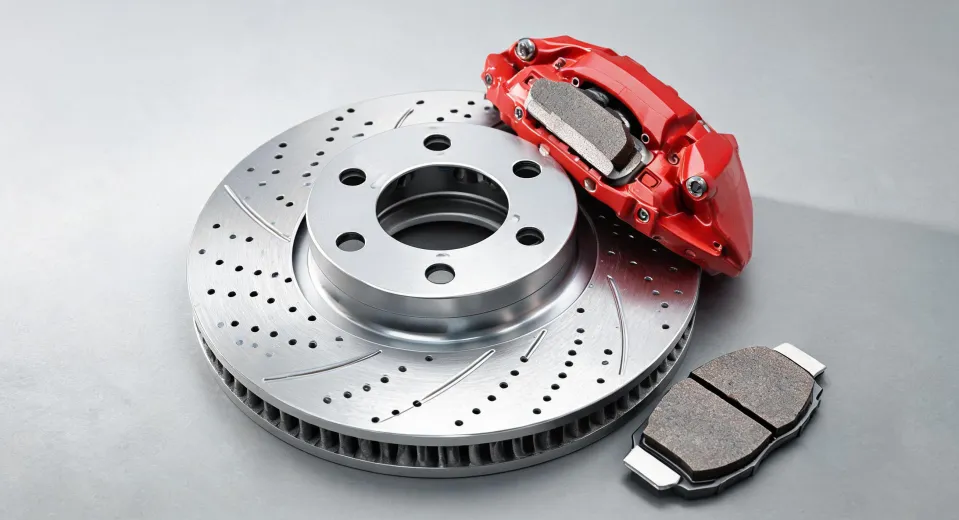
In 2024, we had to replace brake rotors on two of our service vans. I pulled up specifications for Centric vs Powerstop rotors side by side. Powerstop has a strong following in the performance world, and I'll admit that almost won me over. The upside was a small edge in high-temperature braking. The risk was noise—if a van developed brake squeal during a client visit, that's a bad look. I kept asking myself: is that performance edge worth potentially looking unprofessional?
I chose Centric for both vans. The rotors came with a clean anti-corrosion coating, the lug holes lined up perfectly, and after 8,000 miles of mixed city and highway driving, there's not a single squeak. I also compared rotor weights and vane patterns. The Centric rotors were slightly heavier, which usually means more thermal mass—good for repeated stops in city traffic. Powerstop's lighter design might suit a weekend toy, but not a work van loaded with tools. To be fair, Powerstop makes excellent rotors for enthusiasts, but for a commercial fleet, Centric gave me exactly what I needed: consistency. That consistency matters more than a spec sheet.
I also appreciate that Centric offers both coated and uncoated options, so I can match the part to the vehicle rather than forcing one solution across the board.
Specialty Parts: A 2015 Infiniti Q50 Radiator and a 2009 Prius Catalytic Converter
Brakes aren't the only place where quality perception comes into play. Earlier this year, a 2015 Infiniti Q50 radiator started leaking in one of our manager's cars. The part had to be right the first time—downtime means lost productivity. I initially considered a no-name radiator that was $50 cheaper, but then I thought about the cost of installing it twice. That $50 savings would disappear after labor and a second coolant flush.
I ordered a Centric radiator after checking their cross-reference guide online. The unit matched the OEM dimensions exactly, and our mechanic had it installed in just over two hours. No trimming, no extra brackets, no return trips to the store.
Then there was the 2009 Prius catalytic converter for our hybrid pool car. I've never fully understood why aftermarket converters vary so much in fitment. My best guess is differences in tolerance control during manufacturing. The Centric unit bolted up without any modifications, which is exactly what you want when a car is scheduled for a same-day smog check.
These two jobs might seem small, but they represent the kind of quiet reliability that makes a vendor valuable. I didn't have to babysit the installation. I didn't get a callback about missing hardware. The parts simply worked.
Where I Buy: The Home Centric Store
A lot of people ask where I source Centric parts. For quick orders, I use the Home Centric Store online. Their catalog is organized by vehicle and by part type, and they clearly list whether an item is OEM-grade or an alternative. It's not a huge chain; it feels like a specialized distributor that knows automotive parts. The checkout process even lets me upload a VIN for confirmation, which has caught a few compatibility mistakes before they turned into returns.
They also offer bulk pricing for businesses, which helps when we're stocking multiple vehicles. I've had one shipping delay in three years—not ideal, but workable—and their customer service owned the mistake.
The Same Standard Applies to a Honeywell Home X2S Smart Thermostat
Quality perception isn't limited to vehicle parts. Earlier this year, our office HVAC controller finally died, and I had to pick a replacement that everyone would tolerate. I read through dozens of Honeywell Home X2S smart thermostat reviews to understand what real users liked and disliked. The X2S wasn't the cheapest, but it kept coming up as reliable and easy to schedule.
I also asked our office manager to test the app for a week before we committed. She found the scheduling easy, which was refreshing compared to the older controller. We've had it installed for five months now. The interface is straightforward, and the energy savings have been noticeable. I'll admit the mobile app is a little clunky at times, but the core function has been solid. That's the same standard I apply to Centric: on the whole, the product performs well enough that the small warts don't matter.
But Isn't Centric More Expensive?
Some colleagues push back on premium brands like Centric. They point to cheaper alternatives and ask why we don't just buy the lowest-priced rotor or converter. I get that perspective—budgets are real, and I've made plenty of cost-driven purchases for office supplies. A cheap pencil breaks memos; a cheap brake rotor breaks down on a customer's driveway. The hidden costs of low-quality parts are why I document every supplier's return rate and warranty response time.
For anything safety-related or expensive to replace, sticker price is the wrong metric. Consider a rotor that fails at 20,000 miles. You're paying for the replacement part, the labor, the lost vehicle time, and possibly the damaged client relationship. That's why I now calculate total cost of ownership instead of comparing invoices. The $80 saved upfront on an off-brand rotor isn't worth a callback from an upset customer.
It's also worth remembering that product claims need evidence. Per FTC guidelines (ftc.gov), advertising claims must be truthful and substantiated. I apply the same skepticism when I read reviews or listen to vendor pitches. If a brand can't back up its claims, I move on.
That said, I'm not claiming Centric parts are perfect. No supplier has zero defects, and anyone who guarantees that is probably lying. But in five years of ordering Centric components, the failure rate has been remarkably low—and that gives me confidence when I put their name on a purchase order.
Quality Is Your Reputation
The next time you're tempted to save a few dollars on a part, remember what that part says about your organization. It might not be fair, but your parts are your reputation. A vehicle that sounds wrong or leaks fluid in a parking lot creates an impression that no marketing can fix.
That's why I standardize on Centric for automotive components and why I chose Honeywell for our thermostat. I'm not saying every purchase must be premium—just that quality perception should be part of the calculation. Make quality the default, and your brand image will look after itself.