I'm not a mechanic, and I don't pretend to be one. I've spent 14 years buying brake and exhaust components for a family-owned repair group. I've personally made and documented 13 significant ordering mistakes—about $38,000 of budget that went down the drain. Now I maintain our parts verification checklist. That's my day job.
So when I see a search like “Centric brake calipers vs 6 piston brembo calipers,” I don't think brand vs brand. I think job-matched replacement vs. spec-sheet upgrade. That's the real comparison. And it's the one most online reviews don't give you.
The comparison that matters
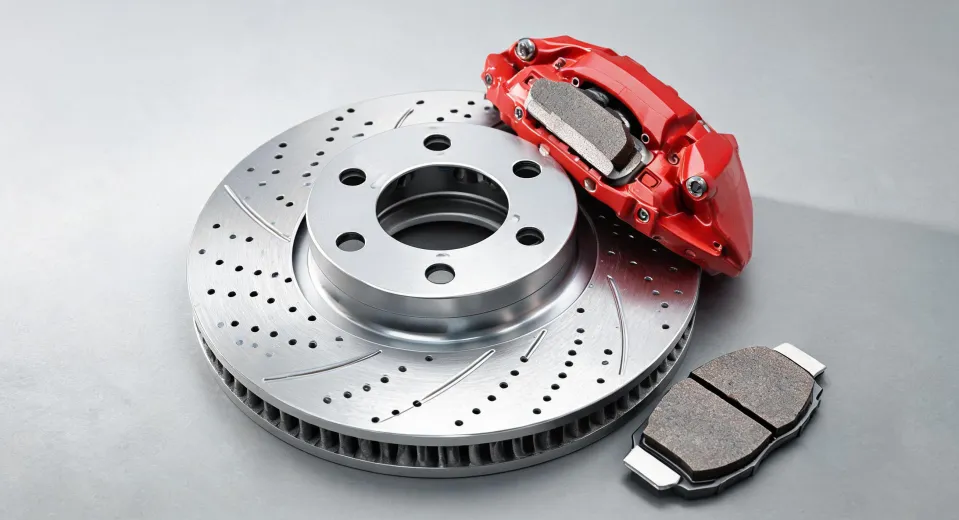
Here's the thing: both options can stop a car. A Centric caliper is designed as a direct replacement. It bolts on, carries the right piston bore, right bracket, right fluid volume. A 6-piston Brembo caliper is designed for a high-performance braking system. It needs the right rotor, pad shape, master cylinder, and often a larger wheel. That's not a knock on Brembo—it's the reality of putting a race component on a street car.
I compare parts on three things: cost per mile, fitment risk, and whether the part actually improves the brake system. Let me walk through each one.
Cost per mile: Centric brake calipers vs 6-piston Brembo calipers
Last year I ordered 30 Centric front calipers for a local fleet of sedans. List price was about $285 each, and we've had no comebacks so far. A comparable 6-piston Brembo kit would have run roughly $1,800 per corner—before the custom master cylinder, brake lines, and wheel spacers. For a mail-delivery fleet? That's not an upgrade. That's a maintenance and insurance problem.
I've also been the guy who saved money on the wrong end. Back in 2018, I bought 40 budget reman calipers to save $65 a unit. The first install took twice as long because the slide pins were out of spec. Two came back with binding pads within six months. We spent about $900 in extra labor and overnight shipping. The “cheap” calipers weren't cheap. I should have stuck with the Centric side of the catalog.
For drum brake work, the Centric Parts 111.07850 brake shoe is another good example. It's one of those part numbers that just works on the cars we service. The lining is consistent and the shoe geometry is right. No-name shoes often need extra grinding on the leading edge to sit properly, which costs time you can't bill. So even though a no-name shoe might be $8 less, the install time eats the savings.
Conclusion: for most vehicles, Centric brake calipers win on cost per mile. If you're building a track car, the 6-piston Brembo calipers can be worth it. But for a daily driver or a fleet, they're usually the wrong tool.
Fitment and installation risk
I've never fully understood why some shops quote a big brake kit without checking wheel clearance. My best guess is because marketing photos only show the caliper, not the wheel. So we now have a rule: before quoting a 6-piston Brembo kit, we confirm rotor diameter, offset, and spoke clearance.
Here's what happened when we didn't. In 2021, I approved a big brake kit for a customer's daily driver. The caliper bolted on fine, but the wheel spoke touched the bleeder screw. We had to order a spacer, then longer studs, then different wheels. The whole bill went from $2,100 to $4,700. The customer was not happy, and honestly, I don't blame him.
Centric calipers don't give us that excitement. They're designed as direct replacements. Every part number has an OE-style fitment, which is why our checklist says “when in doubt, use the OEM-style part.” A direct fit isn't boring. It's the cheapest insurance you can buy.
Conclusion: on fitment risk, Centric wins for any car that has to go to work tomorrow. The 6-piston setup only wins when the whole system is planned together.
The bigger-is-better trap
More pistons don't equal more stopping force. Stopping force comes from clamp force, rotor diameter, and friction. A six-piston caliper can actually feel worse if the stock master cylinder can't push enough fluid.
I had a customer who wanted the largest calipers we could fit on his Japanese sedan. After install, the pedal went soft. Not because the system was faulty—because the master cylinder was undersized for the caliper's fluid volume. We swapped in a bigger master cylinder, then the brake bias changed, and the rear brakes locked too early. The project became a system-engineering project, not a parts swap.
This is why I try to push back on “bigger is better.” Per FTC guidelines (ftc.gov), performance claims like “better stopping” need to be substantiated. We ask for test data before we stock a new brake brand. The suppliers who send dyno charts get our attention; the ones who send only slogans don't.
Conclusion: a 6-piston Brembo caliper is an engineering tool, not a magic upgrade. On a track car with matching brakes, it can be wonderful. On a stock commuter with a small master cylinder, it can be a downgrade.
Exhaust pipe and muffler: same story, louder ending
The same thinking shows up when people search for “exhaust pipe and muffler.” A bigger muffler is not automatically a better muffler. On a small engine, an oversized pipe can cut torque because it kills port velocity. I know backpressure is a contested topic, but I've seen too many 1.6L cars lose mid-range pull after a 2.5-inch exhaust was installed. It went from “noticeable” to “sluggish.”
For normal repairs, I'd rather use a properly sized exhaust pipe and muffler that match the engine's flow needs than a universal “performance” unit that's loud and unsupported. If you're chasing dyno numbers, tune the engine first and size the exhaust to the actual airflow. If you're just replacing a rusted muffler, match the OE diameter and get on with it.
How to stop radiator leak: sealant vs. proper repair
If you've Googled “how to stop radiator leak,” you've probably seen two answers: pour in a bottle of stop-leak, or find the leak and fix it. I've tried both. Here's the honest difference.
A stop-leak product can work on a tiny pinhole, especially in a place that's hard to reach. But it can't fix a cracked plastic end tank or a corroded radiator seam. Worse, it can plug a heater core later. In 2019, we used a $12 bottle of stop-leak on a van with a radiator that looked fine under the cap. Two weeks later it puked coolant on the highway. The tow, the new radiator, and the lost shop time came to about $720.
Now our rule is simple: locate the leak, assess the part, and replace it if the radiator is over five years old or the crack is in a structural area. That's the actual “how to stop radiator leak” answer. A sealant is a temporary tool, not a repair.
What I'd buy now
If you asked me to pick one approach, I'd say:
- Daily driver or fleet vehicle: Centric brake calipers, and Centric Parts 111.07850 brake shoes where the car uses drum brakes. Direct fit, predictable, backed by a real supplier.
- Track car or modified street car: 6-piston Brembo calipers only if you plan the full system—rotors, pads, master cylinder, lines, and brake balance. Buy them as a coordinated kit, not as a single part.
- Exhaust: match the OE pipe diameter unless the engine setup needs more flow. A good muffler at the factory diameter is better than a loud pipe that hurts torque.
- Radiator leak: find the source, replace the damaged part, and refill with the right coolant. Stop-leak only if you need a temporary fix and understand the risk.
No part is “best” in every world. A 6-piston Brembo caliper can be the right answer for a car that lives at the track. A Centric brake caliper is the right answer for almost everything else. The difference is knowing which world you're in before you place the order.
That's the checklist I use now. It took me $38,000 in mistakes to write it—but it's saved us more than that in comebacks and rushed reorders. If it helps one person skip the same error, it was worth publishing.