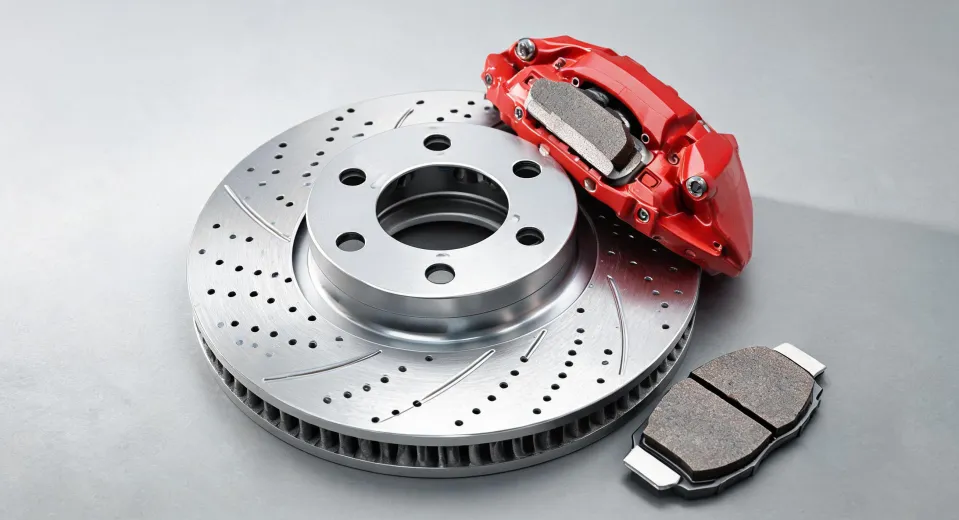
After roughly 300 brake rotor orders since 2020, I order Centric for most of our fleet vehicles and Raybestos only when the application genuinely needs it. That's not because Raybestos is bad — it's usually not — but because Centric has been more consistent in fit, runout, and warranty claims for the passenger cars and light trucks we maintain. If you're choosing between the two for a daily driver, start with Centric. If your car lives in the rust belt and you want a pre-coated rotor, Raybestos Element3 is worth considering.
I'm not a tech. I'm the office administrator for a 43-person logistics company, and I've managed parts purchasing since 2020 — roughly $410,000 across nine suppliers. I report to both operations and finance, so I care about parts that don't come back and invoices that don't create problems. I don't turn wrenches all day, but I do see every returned part, every denied warranty claim, and every 'it still vibrates' follow-up. That gives me a different view than a mechanic. I see which brands cause problems before they even reach the bay.
Why This Comparison Is Based on My Ordering Data
When I took over purchasing in 2020, Raybestos was already the default, mostly because the shop foreman trusted the name. I didn't question it until the return data forced me to. From 2021 through 2024, we ordered about 300 rotors across both brands. Our records show a 2.1% return or warranty rate for Centric versus 4.8% for Raybestos. To be fair, Raybestos is not a low-quality brand. A lot of our Raybestos orders were coated rotors, which cost more and sometimes had coating variations. But for stock replacement on a daily driver, the cheaper Centric blank got the car out and kept it out.
Granted, this is one fleet's buying history, not a controlled lab test. It's still what a purchasing manager should use: purchase records, returns, and time lost to fixes. I'd rather order what fails least on our vehicles than defend a brand name.
Part of my job is translating between drivers, techs, and suppliers. In 2021, I said 'coated rotors for the Ram 2500s.' The supplier heard 'front and rear for every Ram on the lot.' Result: 14 rotors, six of them with the wrong bolt pattern. We were using the same words but meaning different things. We discovered it when the first rotor wouldn't fit over the hub. Now I order by VIN and part number, not by a short description.
Centric vs Raybestos Rotors: How to Choose
Here is how I think about it in the shop. Centric's standard 120-series blanks and high-carbon rotors are our default. They are predictable, easy to find, and we rarely have to measure one twice. Raybestos Element3 coated rotors are what I order when rust protection is the priority. The coating holds up well in road salt, but the cost is higher and lead times are longer. For a normal car that doesn't sit in salt all winter, that premium is hard to justify.
The counterintuitive part: the rotor brand matters less than the person installing it. We once put a $90 Centric rotor on a van and it stopped perfectly. A $210 premium rotor pulsed on a different car because the hub wasn't clean. Once we cleaned the hub and re-torqued the wheel correctly, the same premium rotor ran true. The part was never the problem.
Before I compare Centric and Raybestos for any vehicle, I check four things:
- Vehicle weight and use. A heavy van or tow vehicle needs more thermal capacity.
- Rust exposure. Salt-belt cars get coated rotors; everyone else usually gets bare blanks.
- Runout. We measure new rotors before install. A rotor with too much lateral runout will pulse, no matter the brand.
- Torque sequence. Uneven lug nut torque can distort a new rotor in one test drive.
This is boring. It is also the reason one brake job lasts and another doesn't.
What a 'Centric Store' Actually Means
When someone searches for a Centric store, they usually mean an authorized distributor, not a retail shop. We buy through three authorized Centric store accounts. What matters is the invoice trail and the ability to file a warranty claim without a fight. A part number that comes from an unauthorized seller looks the same until you need support.
The vendor failure in March 2023 changed how I think about source verification. A pallet of coated rotors showed up from a third-party seller with two different coatings and one rotor that didn't sit flush. It wasn't the brand's fault, but it cost us a day of labor and made me look bad to the shop manager. Now I confirm a supplier's authorized status before placing a big order.
According to FTC advertising guidelines (ftc.gov), product claims must be truthful and substantiated. That's a reasonable baseline, but it won't tell you if a specific seller is authorized. So I ignore 'best stopping performance' on the box and check the supplier instead.
The Same Mindset Applies to Other Parts
You might think brake rotors have nothing to do with a fuel pump code or a headlight bulb. In my experience, they are the same category: a symptom tells you where to look, not what to order. Here are three examples that come up regularly.
LED H8 Car Headlight: Don't Skip the Beam Check
H8 is a common bulb size for fog lights and some low-beam applications. We swapped several truck headlights to LED H8 car headlight bulbs. It's usually plug-and-play, but it is not always safe or legal in every housing. A poor LED H8 bulb creates glare because the beam pattern is wrong. We check the cutoff line and make sure the bulb has a driver and heat sink that fit under the dust cap.
Fuel Pump Code: A Symptom, Not a Diagnosis
Whenever a fuel pump code like P0087 shows up, the immediate reflex is to replace the fuel pump. We followed that reflex in 2022 on a delivery van: new pump, code returned. The actual problem was a kinked fuel supply hose. The code said the rail pressure was low; it did not say the pump was dead. More often than not, we now test fuel pressure, filter, and wiring before ordering a pump. A diagnostic code is a lead, not a verdict.
What Is a Transmission Mount on a Car?
If you have ever asked what is a transmission mount on a car, here is the short answer: it is the rubber-and-metal bracket that supports the transmission and keeps the powertrain aligned. When it fails, you feel clunking during acceleration or deceleration, vibration through the floor, and sometimes a shudder at idle. It does not mean the transmission is failing. Replacing a worn mount early can stop more expensive driveline damage later.
Where This Advice Does Not Apply
I recommend Centric for most daily drivers and light fleet vehicles, but I won't pretend it is universal. Here is how to know if you are in the other 20%.
- Track use or heavy towing: order a rotor and pad matched to heat, not a basic blank.
- Salt-belt snowbelt: coated rotors like Raybestos Element3 are usually worth the extra cost.
- Collision repairs: inspect the subframe, mounts, and wiring before buying any upgrades.
- Heavy-duty commercial: verify OE cross-reference and load ratings. Do not trust a generic comparison.
No supplier has a zero-defect rate. Anyone who promises that is selling a story, not a part. In our fleet, Centric has failed least and gone in straightest. That's the whole argument.