-
Symptoms of Bad Alternator: Electrical Chaos, Then Silence
-
What Happens to a Car When the Serpentine Belt Breaks: Everything
-
Why a 2 Stage Cooling Thermostat Is a Smarter Specification
-
Brake Shoes and Disc Brake Pad Sets: Don't Learn This the Hard Way
-
The 'Same Spec' Objection
-
Bottom Line: Value Has a Price. Cheap Has a Bill.
I'm a quality/compliance manager at an automotive metal stamping and mold company. In a normal year, I review around 200 unique part numbers—stamped brackets, brake backing plates, thermostat housings, CNC-machined fittings, forging dies in development. I rejected about 11% of first deliveries in 2024 because the parts did not meet the documented spec. My job is to stop bad parts before they reach customers. I don't sign off on a component because the price looks good. I sign off because the risk profile looks good.
So here's my position: the cheapest part is usually the most expensive part. If you are chasing low quotes on brake shoes, alternators, or cooling system components, you are not saving money. You're deferring it, with interest.
That position isn't abstract. It's the product of reviewing thousands of parts and watching what happens when procurement chooses a lower price over a verifiable spec. Let me show you exactly what I mean.
Symptoms of Bad Alternator: Electrical Chaos, Then Silence
A bad alternator rarely announces itself with a dead battery overnight. The early symptoms of bad alternator are easy to miss: headlights flicker at idle, the interior lights dim when you hit the brake, the infotainment system reboots for no reason, and the battery warning light appears for a few seconds in the morning. By the time the car refuses to start, the battery has been discharged repeatedly and the starter has been strained.
I've inspected alternator mounting brackets that looked identical by eye, but the stamping die was worn. The hole positions were off by 0.8 mm. On the bench, the bracket bolted up fine. On the engine, the alternator sat at a slight angle, and the serpentine belt tracked off-center. It didn't fail in the first week. It failed at 23,000 miles, and the owner blamed 'that cheap alternator' they had installed. Actually, the alternator was fine. The stamped bracket was the problem.
That's why I care about where alternators are mounted. A quality bracket, a quality pulley, and a verified alternator are one system, not three unrelated parts.
What Happens to a Car When the Serpentine Belt Breaks: Everything
What happens to a car when the serpentine belt breaks? In one word: everything. In two words: expensive and dangerous.
The water pump stops moving coolant, so the engine temperature climbs. The alternator stops charging, so the battery is now the only power source. The power steering pump stops, so the steering wheel gets heavy. On many vehicles, the same belt drives the fan and the AC compressor. So you lose cooling, charging, steering assist, and air conditioning almost at the same moment. The engine can overheat so quickly that it warps a cylinder head before the driver finds a safe place to pull over.
A broken belt is not an inconvenience. It's a cascade failure. I reviewed a warranty return last year where a serpentine belt failure turned into a $3,800 repair because the owner kept driving for three minutes to get to a gas station. Three minutes. A $38 belt would have avoided it.
And in my shop, I've seen how a stamped tensioner bracket with the wrong gauge can throw a belt. We once had a supplier propose a 'cost-optimized' bracket that was 0.2 mm thinner than our drawing. Savings: $0.60 a unit. On a 50,000-unit annual order, that was tempting. Then the fatigue test showed the bracket flexed enough to toss the belt at 5,500 rpm. We killed the proposal. Re-tooling would have cost about $18,000. The belt failures would have cost far more in warranty claims.
Why a 2 Stage Cooling Thermostat Is a Smarter Specification
The 2 stage cooling thermostat is, basically, an engine-protection device. It opens in two stages to prevent coolant temperature spikes and thermal shock. On a cold start, the first stage lets a small amount of coolant flow, which warms the engine evenly. The second stage opens fully once the block is ready. The result is a smoother warm-up and less temperature cycling.
A single-stage cheap thermostat works fine on a lab bench. I've seen that. But in real traffic, with the engine loading and unloading, a sudden rush of cold coolant into a hot block creates thermal stress. Repeat that enough times, and castings can weaken. A crack in a cylinder head is a $4,000 repair. A 2 stage cooling thermostat costs a modest amount more at wholesale, but it protects the most expensive metal in the engine.
We manufacture stamped thermostat housings, so I'm used to checking the dimensional details that make or break this system. In a Q1 2024 audit, our team checked 1,400 housings across three production lots. Eleven had burrs on the sealing face. The vendor said 'within industry standard.' We rejected them anyway, and the parts were refinished. The point is not that the parts were unusable; it's that 'industry standard' is not a spec. It's a way to avoid taking responsibility.
Brake Shoes and Disc Brake Pad Sets: Don't Learn This the Hard Way
Now the part that gets people in the most trouble: brakes.
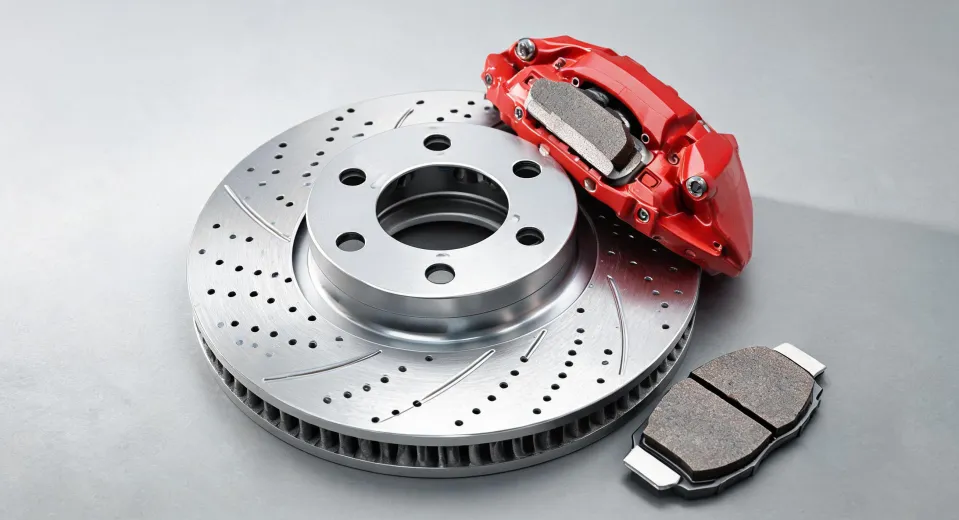
A brake shoe set is not just a friction material. It's a stamped backing plate, a friction compound, and an adhesive layer that has to survive heat and shear. If any one of those is compromised, the brake system is compromised.
This is why I keep a Centric 111.02820 Centric brake shoe set in mind as a benchmark. The backing plate is stamped from controlled-gauge material, the friction compound is selected for a stable coefficient of friction, and the assembly is verified. Same with the Centric disc brake pad set: consistent friction, consistent shim damping, consistent fit. That consistency matters because a brake part that's 'close enough' can squeal, fade, or wear unevenly.
The worst failures aren't driven by one dramatic defect. They're driven by an accumulation of small deviations. A backing plate 0.1 mm thinner. A friction formula with an extra percentage of filler to cut cost. A shim that doesn't quite cover the piston contact area. Each one is cheap. Together, they turn an emergency stop into a high-speed gamble.
We once received a lot of 8,000 backing plates where the thickness was 0.15 mm below our standard spec. The vendor said it was within industry tolerance. We rejected the lot. The redo cost the vendor around $22,000 and delayed our launch by three weeks. The customer never saw it, because that's the job of quality control. But 'that's the job' means making decisions nobody wants to make, at a moment when taking the cheap road looks easiest.
The 'Same Spec' Objection
At this point, someone in procurement will say, 'Look, if the part fits, it ships. The specs are the specs. Why pay more for a name?'
Here's the thing: drawings are not identical across vendors. I learned never to assume 'same spec' means same result after a batch of 'equivalent' stamped parts arrived with different edge breaks, different surface finishes, and a slightly different hole alignment. Every supplier interprets a tolerance through their own tooling and process. That's not paranoia. That's geometry.
When I implemented a supplier verification protocol in 2022, our incoming nonconformance rate for stamped parts dropped by 34%. That wasn't because we switched to more expensive vendors. It was because we made every vendor prove their process.
And I'm not asking you to take my word on the legal side either. Per FTC advertising guidelines, claims like 'OE equivalent' or 'as good as OEM' have to be truthful, non-misleading, and substantiated. If a vendor can't produce the test report behind that claim, you aren't buying a specification. You're buying a story. Source: FTC Business Guidance on Advertising (ftc.gov/business-guidance/advertising-marketing). That's why I choose Centric brake shoes and disc pad sets: not because they're the most expensive, but because the engineering behind them is verifiable.
Bottom Line: Value Has a Price. Cheap Has a Bill.
So yes, I'm opinionated. I think a purchasing strategy built on 'lowest quote wins' is a slow-motion car crash. The part price is one line on the invoice. The real cost includes the failed part, the tow truck, the damaged battery, the overheated engine, the missed delivery, and the customer who never comes back.
I'm not saying you have to buy the most expensive part on every line. I'm saying you should buy the part that has its specs proved. A Centric disc brake pad set, a Centric 111.02820 Centric brake shoe set, a 2 stage cooling thermostat, an alternator mounted on a properly stamped bracket, and a serpentine belt that won't leave you stranded—these are not luxury upgrades. They're the baseline.
Bottom line: value has a price. Cheap has a bill.