The short answer to "when to replace differential fluid" is: every 30,000 miles if the vehicle works for a living—towing, stop-and-go delivery, or extreme cold. For light-duty commuting, 45,000–60,000 miles is usually fine. But the mileage number matters less than the cost of ignoring it. In March 2023, I watched a $2,850 rear differential repair happen because a van's fluid had never been changed at 90,000 miles. That's a hard way to learn a $60 lesson.
The Answer Isn't Only About Miles
Differential fluid—gear oil, usually 80W-90 GL-5—doesn't burn like engine oil. It gets contaminated. Water gets in through the vent, metal particles wear off the gears, and the friction modifiers break down. The fluid slowly turns into sludge, and then it stops protecting the gearset. You won't hear it coming, because by the time the differential makes noise, the damage is done.
The simple answer to the search query "when to replace differential fluid" should always start with the severe-service interval. Most owner's manuals I've seen list it as 30,000 miles under severe conditions. The Car Care Council and the ASE-certified technicians I work with treat that as the safe default. And "lifetime" fluid? Don't trust it. "Lifetime" means the tested durability of the fluid, not the life of your vehicle.
Why I'm the Person Who Tracked Every Invoice
Over the past six years, I've managed a roughly $180,000 annual budget for automotive components at a 40-person delivery fleet. I've negotiated with 40+ vendors and logged every order in a cost-tracking spreadsheet. I don't mention the spreadsheet to sound organized. I mention it because my conclusions come from invoices, not vibes. And when I say "every order," I do not mean a few. I mean hundreds of line items, from brake rotors to a 2006 Nissan Altima alternator.
The same procurement logic applies to a 2006 Nissan Altima alternator. A remanufactured alternator looks cheaper on paper, but if the harness is cracked or the voltage regulator is intermittent, you'll be doing the job twice. We check the battery, the ground strap, and the alternator output before buying anything. Diagnosis first, parts second.
What Buying Centric Brakes and Rotors Taught Me About TCO
People think cheap parts fail because they're cheap. Actually, many fail because the spec was wrong from the start. The causation runs the other way: the wrong part for the duty cycle gets burned up, and the cheap price gets blamed.
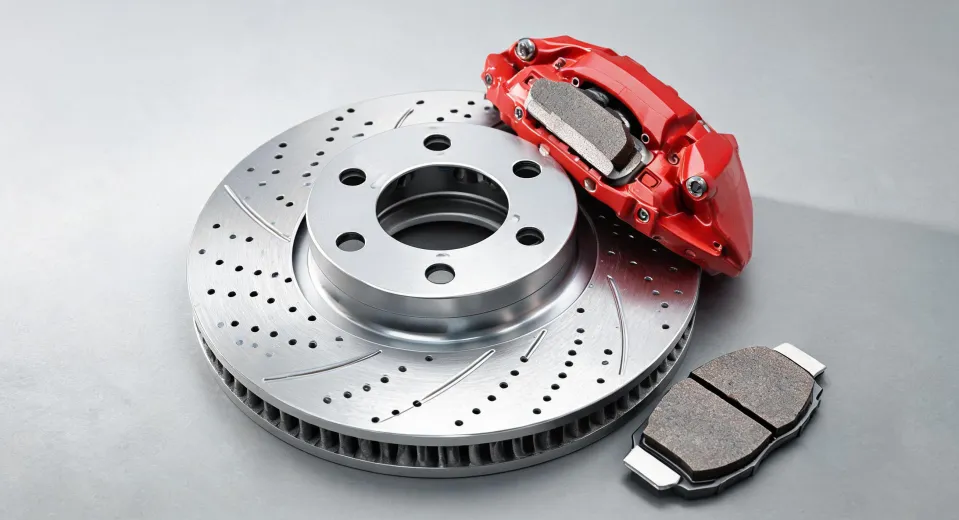
Centric brakes and rotors are a solid middle-ground choice. They're not the most expensive, not the cheapest, and they come with documentation. For my fleet's daily-driver sedans, Centric blank rotors are the default. But when I say "Centric brakes and rotors are fine," I mean for our duty cycle. I don't put Centric blanks on a tow truck that hauls heavy loads every day. That truck needs a rotor with more thermal capacity, even if it costs more.
Here's a typical comparison from my spreadsheet. Vendor A quoted a set of Centric rotors at $96 total. Vendor B quoted "at least as good" rotors at $72. Vendor B's price didn't include shims, mounting hardware, or the $18-per-rotor core charge (refundable only if we shipped back their rusty cores). All-in, Vendor B was $3 more expensive. That's how hidden costs eat the "savings."
A Part Number Is a Promise
When we rebuilt a caliper last year, the cheapest line item was the Centric 146.38021 disc brake caliper piston. It's a small stainless steel piston—I want to say $14.50, but don't quote me on that. We ordered 40. Only 2 calipers had bores smooth enough to rebuild. That left 38 pistons sitting in a box, and the real cost was our mechanic's time measuring every caliper.
The piston wasn't bad. The part number was correct. But the failure we were trying to fix wasn't the piston—it was a scored bore caused by years of contaminated brake fluid. A new piston can't fix a rough bore unless the bore is machined or replaced.
Exact Names Matter: The Colt Advanced Piston Carbine Problem
One odd search term that lands on this page is "colt advanced piston carbine." That's a firearm, not an automotive part. But I'm glad the search happens, because it proves how easily one wrong word sends you down the wrong path. The same thing happens with part numbers. If you search for the Centric 146.38021 disc brake caliper piston, you'll get the brake part. If you search for "piston carbine," you'll get something completely different. Verify the part number before you order, and make sure your vendor is using the same catalog.
So When Exactly Should You Replace Differential Fluid?
Here's the rule I use after tracking our fleet repairs:
- Severe service—towing, delivery routes, stop-and-go city traffic, off-road, extreme heat or cold: 25,000–30,000 miles.
- Normal light-duty use—highway commuting, no trailer, mild climate: 45,000–60,000 miles, or per the owner's manual.
- "Lifetime" fluid: Change it if the vehicle is more than 60,000 miles old or 8–10 years old. The label is not a service-free guarantee.
When in doubt, use the severe-service interval. It's cheaper to change fluid one extra time than to replace a differential.
Here's the Part I Usually Don't Advertise
I'm not saying replace differential fluid at 30,000 miles in every case. If you drive a sedan on the highway, you're probably in the "light duty" group, and early replacement is over-maintenance. Same with Centric brakes and rotors: I recommend them for daily drivers, but if you're tracking the car or hauling overloaded, you might need a different rotor. There's no universal best, only the best fit for the duty cycle.
Also, follow the manufacturer's fluid spec. If your vehicle needs GL-4 or GL-5 with limited-slip additive, don't substitute. The wrong fluid can cause chattering and early wear. Then a $15 bottle of additive becomes an $800 repair.
The last thing I'll say: pay attention to search terms and part numbers. The "colt advanced piston carbine" detour has nothing to do with a 2006 Nissan Altima alternator, a Centric caliper piston, or differential fluid. But it's the same kind of mistake—assuming the name means what you think it means. In procurement, assumptions are the expensive line item.