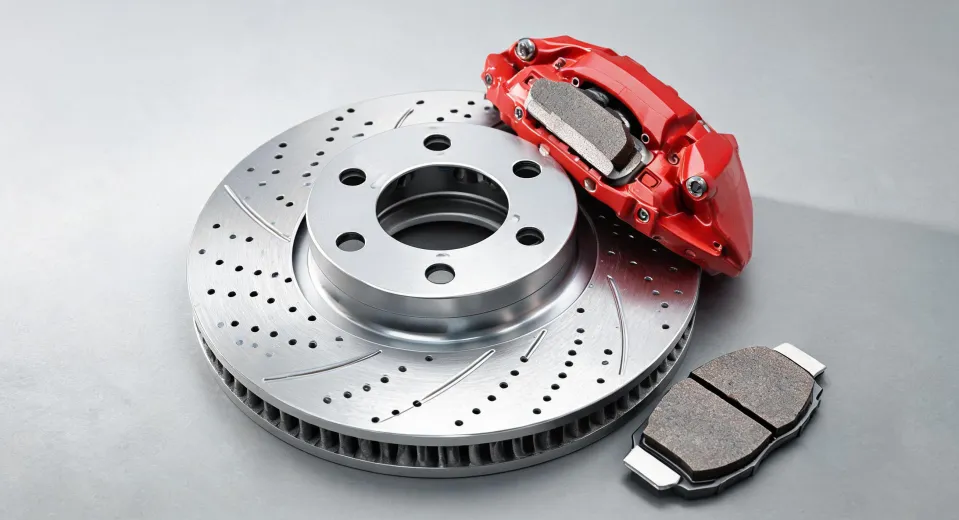
On a 48-rotor order in 2023, I saved $11 per rotor by skipping Centric ctek rotors and buying plain stock. That choice added roughly $1,100 in rework, freight, and lost shop time. After documenting 14 procurement mistakes, the conclusion is simple: total cost, not unit price, is the only honest way to compare brake parts. That same rule applies to a head gasket job, a motorcycle timing chain replacement, and even an exhaust resonator.
I'm not a marketing person. I'm the buyer who maintains the order checklist at a small aftermarket parts supplier, and I've been handling automotive and powersports parts orders for seven years. In that time, I've made (and written down) 14 significant mistakes that added up to roughly $23,000 in wasted budget. I keep the list because I don't want our team to repeat them.
The pattern is always the same: someone looks at unit price, ignores what happens after install, and then pays twice. So if you're comparing Centric brakes and rotors, or debating whether to spend extra on a coated rotor, here's what I'd want you to know before you get burned.
The question everyone gets wrong
The question everyone asks is, "what's your best price?" The question they should ask is, "what's included in that price?"
When I compare brake rotor quotes, I now look at four things:
- Unit price, obviously.
- Coating and corrosion protection, because it affects every future inspection.
- Packaging and freight, which can add 10-20% to a "cheap" rotor order.
- Return handling and restocking, which no one mentions until there's a problem.
None of those extra costs are mysterious. They just take ten minutes to calculate, and most buyers don't do it.
The rotor mistake that rewired my checklist
In my first year (2018), I made the classic specification error: I assumed all "standard" rotors were the same. They aren't. I ordered 48 non-coated rotors because the quote was lower than the Centric ctek rotors. The rotors looked fine on the bench. Not great, not terrible. They looked like perfectly round pieces of metal.
Then the customer saw them after a damp week in storage. The customer didn't care about metallurgy. They saw "rusty rotors" (ugh) and rejected the delivery. We paid freight to get them back, paid a 15% restocking fee, and then paid rush freight to get coated rotors to the customer. Total extra cost: $1,100. The original savings: $528. That is not a good trade.
Here's the counterintuitive part: the cheap rotor wasn't bad at stopping the car. It was bad at shipping, storing, and being perceived as acceptable. In automotive parts, the cost of a part includes the cost of the conversations it creates. A coated rotor prevents an embarrassing conversation before it starts.
Why "how much to change a head gasket" is the wrong question
Whenever someone searches "how much to change a head gasket," they're usually trying to budget a repair. Fair enough. Public repair estimate sites, accessed January 2025, typically put a head gasket replacement between $1,200 and $2,400, depending on engine layout, shop rate, and whether the head needs machining. But the real answer isn't a number. It's a follow-up question: why did the head gasket fail?
If the engine overheated, the head may be warped. If you install a new gasket on a warped head, it fails again. If the timing chain is already in the way, a new chain while the engine is open can save $500 to $900 in labor later. I've seen a $1,300 head gasket quote become a $1,900 "while we're in there" quote that saved the customer from paying the same labor twice. That's total cost thinking.
The same logic applies to a motorcycle timing chain replacement. On a motorcycle timing chain replacement, the chain might be $80 to $200, but the labor is the expensive part. If you're already in there, replace the guides and tensioner too. The "cheap" chain only makes sense if you plan to sell the bike next week.
And before you laugh at the rotor guy bringing up exhaust parts, the same thinking applies to a Republic resonator. A no-name resonator might save $40 and then drone at every rpm range. A Republic resonator, or any name-brand unit, usually comes with a published spec sheet and a smaller chance of a "can you make it quieter" callback. The labor is the same either way. The cheapest part isn't the cheapest job.
The TCO checklist I use before any brake order
I have mixed feelings about coating upcharges. On one hand, they feel like an upsell. On the other hand, I've paid the cost of not buying them. Today I'll order Centric brakes and rotors for most stock orders, not because the brand is magic, but because my own checklist data is clear: fewer balance issues, fewer coating complaints, fewer weird conversations.
Here's the pre-order checklist I've maintained since Q1 2024:
- Define the service life. Is this part going on a daily driver, a race car, or a fleet vehicle?
- Add every cost: freight, packaging, restocking, warranty handling, and potential labor comebacks.
- Compare coating and tolerance specs, not just part numbers.
- Ask the supplier what happens if the part needs to be returned. A 15% restocking fee changes the math quickly.
- If in doubt, choose the part you can defend in front of a customer.
That last one sounds kinda soft, but it isn't. A customer who hears "we saved you $11" forgets it in a week. A customer who sees rust on a rotor remembers it for years.
Dodged a bullet earlier this year when the checklist caught a mis-spec before ordering 60 rotors. One click away from a $4,000 mistake. That's why I'm willing to sound like a broken record about this.
When total cost thinking goes too far
I don't want to overcorrect and tell you that premium parts are always the right answer. They aren't. If a vehicle is being scrapped in six months, buy the cheapest safety-compliant part that meets the spec. If you're racing and expect to cut rotors every other weekend, a coated street rotor might be wasted money. If the vehicle is old enough that parts aren't available, sometimes the "wrong" part is the only part.
Total cost thinking is a framework, not a religion. It starts with one question: what is this part supposed to do, and how much will it cost over its whole life? I document mistakes because the next one is out there somewhere. I just don't want to pay for it twice.