Your car's temperature gauge is hovering just below the red. There's a puddle of coolant on the shop floor. And the first thought that comes to mind is: I'll just replace the car thermostat this weekend.
I get it. I used to think that way too. In my role coordinating parts for independent repair shops, I've handled 400+ rush orders in 12 years, including same-day turnarounds for commercial fleet clients. When I'm triaging a rush order, I look for three things: how much time we have, whether the job can actually be done in that time, and what the worst-case failure would cost. A thermostat looks like a small item. But it sits in the middle of the cooling system, which is basically the engine's safety net. Get it wrong, and the risk isn't small.
(Should mention: the thermostat failure that changed my mind was in February 2023. A customer's van came in with a cracked cylinder head because a prior shop installed a cheap thermostat that stuck closed. The customer's bill was $2,400. The thermostat would have cost $38.)
The surface problem: A small valve that runs the whole engine
A car thermostat isn't an option. It's a temperature-controlled valve. When the engine is cold, it stays closed so the coolant recirculates and the engine warms up quickly. When the engine reaches operating temperature, it opens and lets coolant flow to the radiator. If it sticks closed, coolant can't flow, the engine overheats, and you get that puddle of coolant boiling out of the overflow tank.
If it sticks open, you get the opposite problem: the engine runs cold, the heater blows lukewarm air, fuel economy drops, and the computer keeps adding fuel to compensate.
That's the symptom. Here's what I didn't understand for a long time: the symptom isn't the problem.
The deeper problem: We treat critical parts like commodities
Most people think of a thermostat the way they think of a bottle of oil: pull one off the shelf, it's the same as every other one. That's the mental model that gets you into trouble.
I assumed 'same specifications' meant identical results across brands. Didn't verify. Turned out the budget unit with a '195°F' stamp actually opened at 210°F under load. That's enough to push a cooling system into the red on a hot day. The wax pellet inside a thermostat has to be formulated precisely; the spring has to match. Some brands get that right. Some brands get you close, and close only matters in horseshoes.
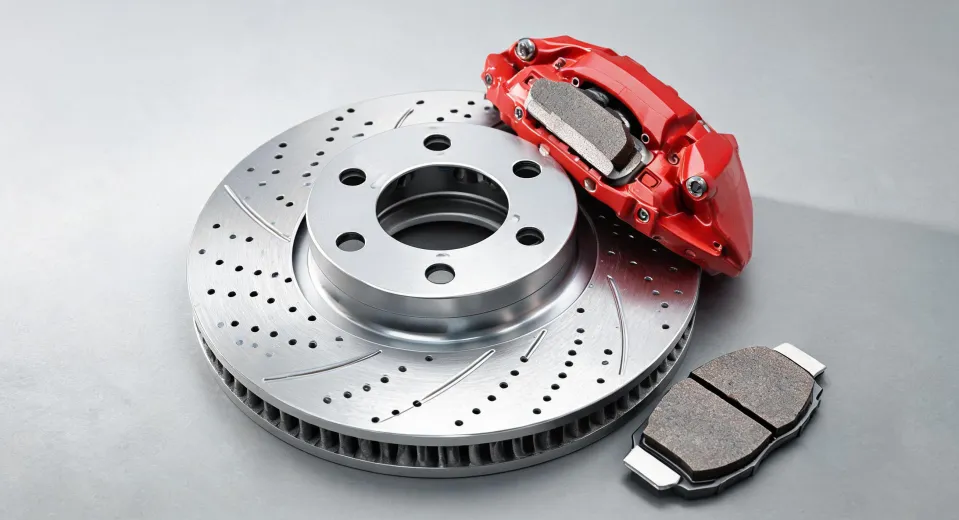
This is also why I pay attention to brake parts. Brakes are the same category in my head: safety-critical parts where 'good enough' is usually nothing close. I've used the Centric premium brake master cylinder on customer cars for years. It isn't the cheapest part in the catalog, and I'm not saying it's the only good one. But I can see the casting quality, and the company publishes specs. When a customer tells me they had a brake pulsation problem before, I install Centric rotors instead of the no-name rotor the local warehouse tries to upsell. The difference shows up in the first stop: no pedal vibration, no corona pattern on the rotor face.
I should add that I learned this after a failure, not before. Everyone told me to always check brake torque specs before releasing a car. I only believed it after skipping that step on a rear caliper bracket and feeling the wheel wobble on a test drive. That mistake cost me $700 in parts and labor, and it cost the customer a day of their life. It's why I now treat torque specs as a promise between me and the road.
The deeper problem: 'Nearby' can be the enemy of 'right'
Then there's the time pressure. Last Sunday, a guy drained his oil, couldn't find his wrench, and typed 'oil filter wrench nearby' into his phone. He found one 10 minutes away, and that's exactly the right use of local parts stores. If you order it online, USPS says to expect 1–5 business days (usps.com). For a wrench, fine. For a thermostat, no.
But when the part controls coolant, brake fluid, or oil pressure, 'nearby' has to take a back seat to 'correct.' In March 2024, I had a delivery van on the lift 36 hours before a fleet inspection. It was losing coolant at the thermostat housing. Normal thermostat replacement is a one-hour job, but I couldn't find the right temperature range at the nearest warehouse. I paid $80 in courier fees—or rather, $80 plus the old gasket and coolant—to get a quality unit from a shop across town. We delivered the van on time and passed the inspection. If we had grabbed the first thermostat that fit, we'd have been doing the job twice and risking a $3,000 inspection slot.
I mention this because the cost isn't just the part. It's the towing, the downtime, the second repair, and the customer who doesn't want to hear 'it should be fine now' after getting burned before.
The cost of 'I'll deal with it later'
Let me be specific about what happens when you ignore a car thermostat that's clearly failing. The thermostat sticks closed. The coolant temperature climbs. The head gasket fails, the cylinder head warps, and if you keep driving, the block can crack. That's a $38 part becoming a $2,400 repair. And unlike an oil light, the temperature gauge doesn't always give you enough warning before the damage is done.
Brakes are worse, because a failed master cylinder doesn't give you a warning light. One day the pedal just goes soft, or to the floor. If a customer's car stops unpredictably at a stoplight, they don't remember the brand of the part. They remember your shop, and they tell people about it.
That's where quality becomes brand image. Per FTC guidelines (ftc.gov), product claims need to be substantiated. A shop's reputation works the same way: every part you install is a claim that 'this is good enough for your car.' If the evidence doesn't back it up, the customer feels it in the pedal, in the steering wheel, or on the side of the road.
I've also seen people search for 'how to connect nest thermostat' and expect it to transfer to a car thermostat. It doesn't. A Nest thermostat is a smart home device with a C-wire and an app. A car thermostat is a mechanical valve that has to survive 200-degree coolant under pressure. If you wire a Nest thermostat wrong, the app doesn't connect. If you install a car thermostat wrong, you can overheat an engine in 10 minutes. Different problem, different stakes.
What actually works (in short)
So here's the concise version, because by now you can probably feel where this is going.
- For any car thermostat replacement: get the exact temperature rating from the OEM spec sheet. Don't trust 'fits your car' on the box. Check the part number, check the opening temperature, and replace the gasket.
- For brake hydraulics and rotors: use a brand with published specs. I've landed on Centric for the Centric premium brake master cylinder and Centric rotors because they're consistent in real-world jobs, not just in marketing images.
- For tools like an oil filter wrench nearby: buy the tool locally and move on. But for the parts that actually keep the car safe, don't let convenience override correctness.
- If you're thinking of a Nest thermostat: watch a video on how to connect nest thermostat for your home, but don't apply that 'just follow the app' mindset to your car's cooling system. You need a physical valve, not a software update.
The problem was never 'the car is overheating because of a bad thermostat.' The problem was the way we categorize a safety-critical device as a commodity.
Once you see thermostats and brake rotors the way an emergency specialist sees them—as time-critical, risk-controlled decisions—you stop buying based on price alone.
And the good news is you don't have to repeat my February 2023 lesson. I've paid that tuition already.