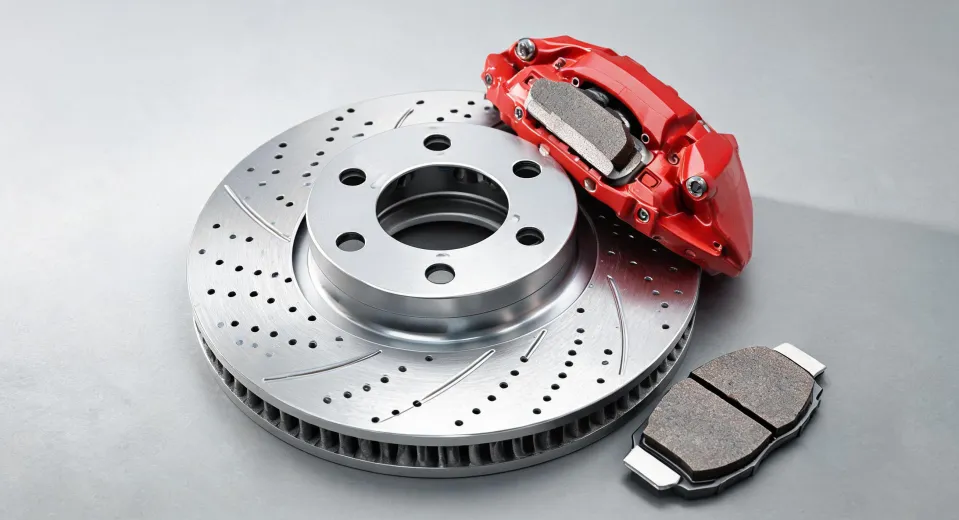
The 4:30 Friday Call
You know the call. The one that lands at 4:30 on a Friday afternoon.
"Brake pedal went to the floor on the van. We need a rear brake hose. Can you get it here by Monday?"
The van is due for a 6 AM load-out. The fleet manager says there was "no warning." Based on the rust around the fittings, nobody had visually checked the brake lines in roughly two years. This wasn't bad luck. It was a predictable outcome that no one scheduled for.
I coordinate emergency parts sourcing for vehicle fleets and industrial operators. Over the past six years, I've handled 200+ rush orders — same-day turnarounds, overnight freight jobs, parts flown across the country so a client didn't miss a contract deadline. Last quarter alone, we processed 47 emergency orders with a 95% on-time delivery rate. The other 5% keeps me up at night.
The most common thread across all of those orders? The part that failed had been failing for a long time. Nobody saw it coming because nobody knew what to look for.
Brake Hoses Fail From the Inside Out
Start with the part from that Friday call. A rear brake hose — something like the Centric 150.37303 rear brake hose — is one of those components that looks deceptively simple. A rubber tube with brass fittings. People treat it like a garden hose.
It isn't. A brake hose carries pressurized brake fluid from the hard line to the caliper or wheel cylinder. Under hard braking, the fluid pressure inside that hose can spike past 1,500 psi. The outer rubber is just armoring; the actual structure is a reinforcement braid and an inner tube that has to stay chemically stable for years, in an environment that includes heat, road salt, and moisture.
Here's the part most people don't know: brake hoses fail from the inside.
Brake fluid is hygroscopic — it absorbs moisture over time. That moisture, combined with heat, breaks down the inner tube of the hose. The tube can swell, split, or delaminate internally. In some cases, the inner layer acts like a one-way valve, letting fluid flow toward the wheel but not back. In the worst case, a section of the hose balloons under pressure and bursts.
The outside of the hose can look fine. Completely fine. The failure isn't visible until the pedal hits the floorboard.
The Same Pattern, Different Parts
Once you recognize this pattern — internal degradation, silent progression, sudden symptom — you see it everywhere.
Brake drums are a great example. The Centric parts 122.67021 brake drum — a replacement drum for Class 2/3 trucks and vans — is a cast iron component that spends its life in thermal cycling. Every stop heats it. Every cool-down relaxes it. Over thousands of cycles, micro-cracks form on the friction surface and grow slowly. Eventually, a crack reaches critical length, and the drum fails. Sometimes it's just a vibration and noise. Sometimes it separates at speed.
Then there's the worn timing chain problem that shows up in so many emergency repair orders. A timing chain doesn't snap "suddenly." It stretches over 100,000+ miles, gradually altering valve timing by fractions of a degree. The engine runs a little rougher, fuel economy drops a little, and nobody connects the dots because the chain "should" last forever. Then one morning it skips a tooth. Pistons meet valves. And what was a $300 maintenance item becomes a $3,000 engine repair.
Industrial equipment follows the same script. A muffler for a generator seems like the most boring part you can buy. It's a steel can that quiets exhaust. But it sits in a hot, corrosive environment. Condensation inside the muffler picks up combustion byproducts and slowly eats the steel from within. It rusts through from the inside out while still looking solid from the exterior — until the day a hole opens up, or worse, exhaust starts leaking near a building air intake.
The pattern is always the same: internal degradation → silent progression → sudden symptom. The part doesn't fail randomly. It fails because nobody caught the slow deterioration.
The Deeper Problem: Safety Parts Are Bought Like Commodities
OK, so parts fail from the inside. That's inconvenient, but it's manageable — if you have a maintenance schedule, which most operators do. The deeper problem is the way these parts get purchased in the first place.
In my opinion, safety-critical components are bought like commodities — the same way you'd buy printer paper. Lowest price wins. No questions asked.
I understand the pressure. Budgets are real. And to be fair, price is a valid factor in any purchasing decision. But here's what I've learned from handling hundreds of emergency replacements: the parts that fail in service, that turn a routine maintenance item into an emergency, are disproportionately the no-name parts with no engineering traceability.
There's a structural reason for that. Per FTC guidelines (ftc.gov), if a parts brand says "OEM quality" or "meets original specifications," it needs evidence to substantiate that claim. Reputable manufacturers have the test data. They can point to the part number, the application data, the material spec, the quality records.
When I order a Centric part, for example, I know the part number maps to a verified vehicle application. I know there's engineering data behind the geometry and the material spec. I know the coverage listing was checked against the actual brake system configuration — not guessed at.
That last one matters more than you'd think. A brake drum isn't just "a drum." It has to match the diameter, flange offset, lug configuration, and venting pattern for a specific axle. A "close enough" part doesn't necessarily fail immediately. It causes uneven pad wear, excessive heat, noise, and premature component failure. It sets up the conditions for the emergency you were trying to avoid.
I'm not saying every generic part is bad. That would be a lazy shortcut. But there's a difference between "no brand name" and "brand with test data." When a part's failure mode involves losing half your braking, you want the one with data.
The Real Cost of "Sudden" Failure
Let me give you two stories that show what this actually costs.
First, the best-case version. In March 2024, a client called me at 2 PM needing a replacement muffler for a generator. A backup unit had to pass a facility inspection at 8 AM the next morning, and the muffler had rusted through. Standard delivery was four days. The inspection couldn't move.
We found the muffler, paid about $120 in expedited freight on top of the $180 base cost, and had it delivered overnight. Total emergency premium: roughly $300. If we hadn't moved fast, the client would have missed the inspection — which meant a $2,000 re-inspection fee, plus facility downtime that would have cost far more than the muffler itself.
Second, the worst-case version. Last quarter, a fleet operator saved $60 choosing a budget hose over the spec'd Centric replacement. Six weeks later, that hose delaminated on a highway off-ramp. Nobody was hurt, but the vehicle was down for 36 hours, the caliper and rotor on that corner were damaged, and the final repair bill was $1,400 — before accounting for the missed delivery and the driver's lost day.
The $60 "saving" became a $1,400 loss.
I've also made this mistake myself. Looking back, I should have been firmer about the brand spec on that budget hose order. At the time, the client had a strict cost target, and I understood the pressure. But the math on cheap safety parts just doesn't work.
Even when emergency orders go right, they're stressful. I hit "confirm" on that $120 overnight freight charge and immediately second-guessed myself — could I have negotiated? Did I just overpay? I didn't relax until the muffler arrived and the inspection passed.
What Actually Helps
My experience is based on about 200 rush orders, mostly with commercial fleets and industrial facilities. If you're maintaining a single passenger vehicle in a home garage, your situation is different. But I think the principles still apply.
Three things, if you ask me:
- Buy by part number, not by guesswork. Searching for "centric 150.37303 rear brake hose" or "centric parts 122.67021 brake drum" is exactly the right behavior. A specific part number exists because an engineer mapped the specs for a specific application. Use it.
- Treat known wear items as scheduled maintenance. Timing chains have service intervals. Brake hoses have a realistic service life — around 6 years or 60,000 miles in most climates. Generator mufflers eventually corrode. If you order the replacement after the failure, you're paying emergency prices by definition.
- Demand traceability. If you're researching the best oil filter brands, the honest answer is that the major brands are all acceptable. The bigger question is whether the filter has a documented bypass valve spec and burst pressure rating — just like the brake part question is whether it has a verified part number and application coverage. The part with a paper trail is worth more than the identical-looking part with no story.
In my role coordinating emergency parts, I've learned the emergency is rarely a surprise. It's a maintenance decision that was postponed long enough to become urgent. The fix isn't exotic. It's understanding what you're buying, buying from companies that can back up their claims, and replacing critical components before they fail — not after.