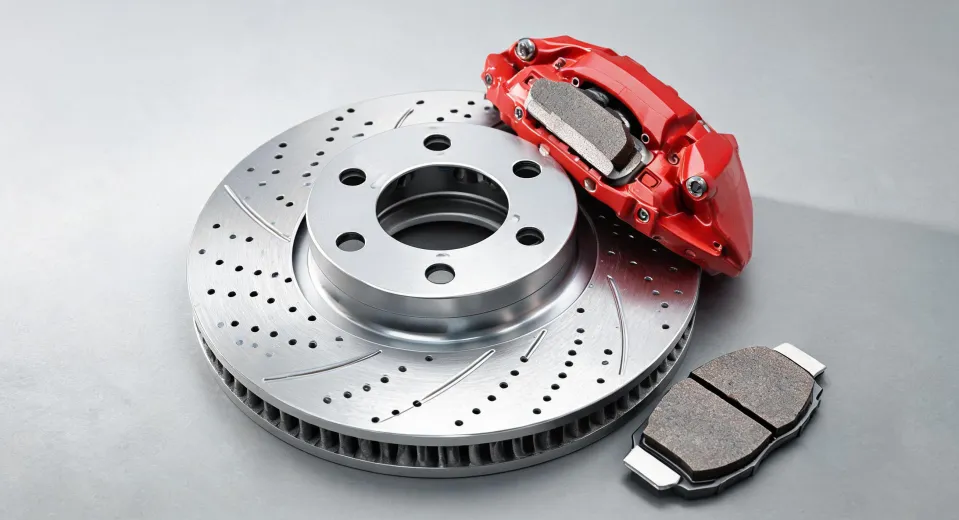
I'm a quality compliance manager at an automotive components manufacturer. I review roughly 200+ unique parts before they reach customers—brake rotors, master cylinders, stampings, CNC-machined components, you name it. In 2024, I rejected 11% of first deliveries due to spec non-compliance. And in almost every dispute that followed, the pattern was the same: someone chose the cheaper part, and the cheaper part cost them far more than the part they were trying to avoid buying.
Here's my position: in automotive parts, total value beats unit price every single time. The cheapest quote isn't a saving—it's a bet that nothing will go wrong. And I've watched that bet fail too many times to stay quiet about it.
A Brake Rotor Batch That Cost 47x More Than It Saved
In Q1 2024, we received a batch of 6,000 brake rotors where disc thickness variation (DTV) was visibly off—measuring 0.028 mm against our 0.015 mm standard spec. Normal tolerance is ±0.005 mm. The vendor claimed it was "within industry standards."
We rejected the batch. They redid it at their own cost. But the customer's assembly line sat idle for nine days. At roughly $4,200 per hour of lost production, that's about $900,000 in downtime. The "cheaper" rotors would have saved that customer $3.17 per unit—about $19,000 total. The failure ended up costing them 47x the amount they saved.
This is why I push back when procurement asks about the price of a Centric 130.33425 brake master cylinder or Centric brake rotors. The question isn't the upfront price. The question is what it costs when a part fails.
The Hidden Line Items Nobody Quotes
A customer once asked me, "how much is a alternator at AutoZone?" They wanted to compare it directly with our supplier's price. I understand the instinct. But let's run the full numbers on a typical remanufactured alternator—as of December 2024, roughly $119–$160 before core charge at most major auto parts retailers.
- Labor if it fails in six months: $80–$150
- Towing if it dies on the highway: $150–$250
- Rental car while your vehicle sits in the shop: $45/day
- Your own time lost: whatever your hour is worth
That "bargain" alternator can easily cost $500+ in real terms. A quality unit at $200–$250 is still the cheaper option.
The same logic applies to a Camaro catalytic converter. A no-name brand might save you $200 upfront. But if the substrate degrades prematurely—which happens more often than the aftermarket likes to admit—you're looking at a check engine light, an emissions failure, and a replacement job that involves cutting and welding. That's a $1,500 problem from a $200 "saving."
You don't even need to leave the drivetrain to find examples. A Kohler engine air filter—for a commercial lawn mower or a garden tractor—seems like a simple purchase. But a filter that doesn't seal correctly lets unfiltered air into the engine. I've personally seen a $12 off-brand filter destroy a $2,800 engine in under 400 operating hours. The buyer tried to save twelve dollars.
What I Believed Early in My Career—and Why I Was Wrong
Everything I'd read said to get multiple quotes and pick the most competitive one. Suppliers were interchangeable. A part is a part. That was the conventional wisdom.
My experience with 200+ orders over four years suggests the opposite. The lowest quote has cost us more in roughly 60% of cases. Sometimes it was a slight tolerance deviation in a stamping die. Sometimes it was a master cylinder that leaked during pressure testing. Sometimes it wasn't even a quality issue—it was a delivery delay that threw the entire schedule off.
What I eventually realized: consistency is the real measure of a part. A component that meets spec once out of ten tries is worthless. A part that meets spec every time, backed by documented process control, is worth its weight in gold. You can't see that in a line-item price comparison.
I'll admit, I'm not sure why lowest-price-first is still the default in so many purchasing departments. My best guess is that procurement metrics reward short-term savings over long-term reliability. Quarterly budgets create short-term thinking. But the math doesn't care about accounting periods.
Put another way: you're not buying a brake rotor. You're buying stopping power at 70 mph in the rain. The price tag is just the entry fee.
But What About Budget Constraints?
I hear it constantly: "The cheaper supplier is the only one we can afford right now." Budget pressure is real. I've been there—I once approved a lower-priced vendor with two hours to decide because a production deadline was looming. Normally I'd run a full audit, but there was no time.
Even after the parts arrived, I kept second-guessing what I'd approved. Those rush orders failed at a 6% rate that quarter, versus our usual 0.8%. The rework costs ate double the amount we'd saved on the initial purchase. In hindsight, I should have pushed back on the timeline. But with a production manager standing over my shoulder, I made the best call I could with the information available.
If your budget can't accommodate a quality part, it can't accommodate a failure either. I don't say this lightly. Quality isn't a premium feature. It's the cheapest insurance you'll ever buy. Instead of comparing unit prices, run a total cost of ownership model: inspection costs, historical defect rates, downtime risk, warranty exposure, expedite fees. When you run that model, the lowest quote almost never wins.
Buy Value. Buy the Part That Never Comes Back.
To be clear, I'm not saying every part should be the most expensive option. I'm not saying brand names guarantee perfection—plenty of cheap parts perform perfectly well. And I'm definitely not saying you should ignore price entirely. What I am saying is that "cheapest quote wins" is a fundamentally broken decision framework.
When you compare Centric brake rotors against a generic alternative, don't ask which one is cheaper. Ask which one will still be within spec—without vibration, without premature wear, without safety risk—after 30,000 miles of real-world driving. Same logic applies to the Centric 130.33425 brake master cylinder. You're not buying a cylinder. You're buying confidence when a deer jumps out or the car ahead of you brakes hard.
At our facility, we operate under IATF 16949, the global automotive quality management standard. That certification requires documented process control, full traceability, and continuous improvement—not just for our stampings and CNC-machined parts, but for every brake component we ship. It's a standard that exists because the cost of failure in automotive parts is never just the part itself.
So the next time you're about to search "how much is a alternator at AutoZone," try a different search instead: "alternator failure rate by brand." Or ask your supplier for their PPM—defective parts per million—and their process control documentation. That's where the real information lives.
The most expensive part you'll ever buy is the one that fails. Buy value. Buy reliability. Buy the part that never comes back.