-
1. Are Centric 120 rotors any good?
-
2. What do Centric premium brake rotor reviews actually tell you?
-
3. Will the Westar EM-3066 transmission mount fit my car?
-
4. How do I know a 33405 fuel filter is correct for my car?
-
5. How long can I drive with a bad ignition coil?
-
6. What is the one habit that prevents most replacement-part mistakes?
For the past nine years, I have been the person ordering and checking aftermarket auto parts before they go out the door. I have also made enough mistakes to keep a list: 23 notable errors, roughly $4,100 in wasted parts and labor. Most of them came down to the same problem. I trusted a catalog screen instead of the part in front of me. This FAQ is the checklist I wish I had back then.
1. Are Centric 120 rotors any good?
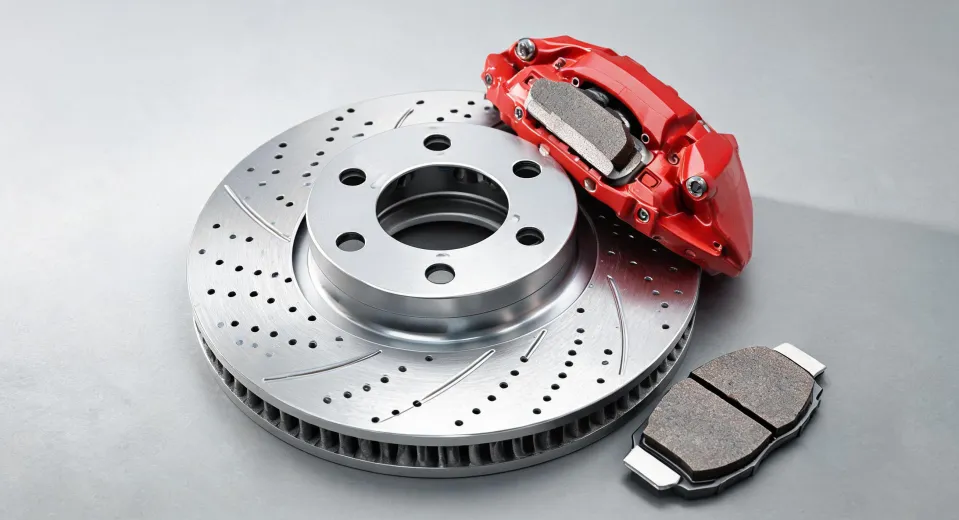
The honest answer is that good depends on what the car is being asked to do. I have ordered Centric 120 rotors many times. They are usually treated as an OE-style replacement rotor, not a racing or heavy-duty upgrade. For normal street driving, that is not a bad thing. The most expensive rotor in the catalog is not automatically the right rotor.
What I learned the hard way is that the part number search is only the start. I once approved a Centric 120 rotor for a vehicle that looked correct on the website. The rotor sat on the hub and could have fooled anyone for a minute. But the lug count was wrong. That mistake would have gone straight to the customer if we had not done a final check. Now I compare lug count, hub bore, diameter, and minimum thickness before ordering. A five-minute physical check beats a five-day return process.
Also, measure the old rotor before assuming it needs replacement. Most rotors have a minimum thickness number cast into the hub or outer edge. If you are below that number, you cannot machine it safely. If you are not below it, the problem might be the pads, caliper slide pins, or a bad wheel bearing. The rotor is not always the villain.
2. What do Centric premium brake rotor reviews actually tell you?
Centric premium brake rotor reviews can point you in the right direction, but they miss a lot of context. Most happy reviews are written within the first few hundred miles. Most negative reviews are written by someone whose part did not fit or whose brake pedal still pulsed after installation. That does not necessarily mean the rotor was bad.
I compared two identical sets of rotors in 2024. One set was installed by a quick shop that did not use a torque wrench. The other set was torqued in stages, with clean hub surfaces and new mounting hardware. The first set pulsed at around 3,000 miles. The second set felt fine. Same rotor, different installation. That comparison changed how I read online brake rotor reviews.
When you read any premium brake rotor review, ask whether the reviewer cleaned the hub face, torqued the lug nuts evenly, and bedded the pads properly. If those steps were skipped, the part gets blamed for something the installation caused. Rust on the outer edge or hub face is also not proof of a bad rotor. The friction surface and true runout matter far more than what a photo shows.
3. Will the Westar EM-3066 transmission mount fit my car?
The Westar EM-3066 transmission mount is a part number, not a promise. Application guides are useful, but they are only as good as the vehicle information you enter. I have paid real money to learn that same model and same year can still have different transmission codes, different bolt patterns, or a different mount design.
In 2022, I ordered a batch of mounts for a common application. The Westar EM-3066 transmission mount looked correct in the catalog, but the stud spacing did not match the transmission code on the actual vehicle. The mount was close enough to look like it might work. Close is not good enough for something that holds a powertrain.
Before you order, check the OEM part number, engine code, and transmission code. Also look at the old mount. If the original is fluid-filled, do not replace it with a solid rubber mount unless you want a change in vibration and noise. If the old mount is soaked in oil, find the leak first. A new transmission mount will not fix a rear main seal leak, and it will be soaked again.
4. How do I know a 33405 fuel filter is correct for my car?
I cannot tell you from the 33405 fuel filter number alone, and neither can a search result. Part numbers like this are a starting point. Fuel filters look similar, but the inlet and outlet style can change from one production year to another. I saw this happen with a shop order in 2021. The requested 33405 fuel filter had the right brand family, but the vehicle had a mid-year fuel line change and needed a different connector version.
Check three things before ordering: the OEM cross-reference, the connection type on both ends, and the direction of flow. Fuel filters are directional. If the arrow points backwards, you can starve the engine or overwork the fuel pump even with a new filter.
Also, do not wait until the fuel pump is noisy to replace a filter. A restricted inline fuel filter makes the pump work harder and can shorten its life. Replacing the filter is cheap. Replacing the pump is the kind of repair that ruins a budget. When in doubt, look up the VIN and confirm the exact variant. It takes an extra two minutes and prevents an annoying comeback.
5. How long can I drive with a bad ignition coil?
Short answer: I would not drive any farther than necessary. If you ask how many miles you can cover before the coil dies completely, that is the wrong question. The real risk is not the coil itself. The real risk is what the misfire does to the catalytic converter.
A bad ignition coil causes a cylinder to misfire. Unburned fuel goes into the exhaust, heats up the converter, and can destroy it. I saw this happen with a customer in 2023. They had a misfire code and a rough idle. They decided to wait ten days before booking the repair. By then, the catalytic converter was damaged, and what should have been a simple coil replacement turned into a much larger bill.
If the check engine light is flashing, stop driving and get the car to a shop. A flashing light means the misfire is serious enough to damage the converter right now. If the light is steady, you might have a little more time, but it is still a gamble. Do not use a bad ignition coil as an excuse to test how many miles a catalytic converter can survive.
6. What is the one habit that prevents most replacement-part mistakes?
Every story in this FAQ has the same lesson. A bad ignition coil, the wrong Centric 120 rotor, a Westar EM-3066 transmission mount with mismatched stud spacing, and a 33405 fuel filter with the wrong inlet all look acceptable until they are compared with what the vehicle actually needs.
The habit that saves me now is a simple pre-order check. Compare the old part to the new part before installation: lug holes, center bore, connector shape, direction arrows, brackets, and mounting holes. Then look up the OEM part number instead of trusting only the aftermarket listing. Finally, find out why the old part failed. If it failed because of another problem, replacing only the part is not prevention; it is postponement.
I still make mistakes, but I make fewer of them. Five minutes of verifying is cheaper than five days of explaining. The best repair is the one you only have to do once.