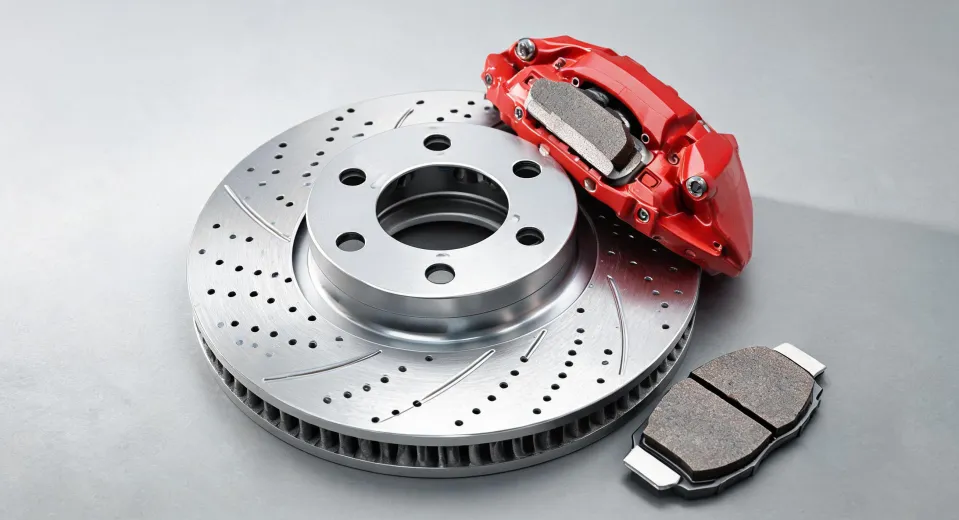
The OEM Assumption That Almost Cost Us
When I first stepped into quality compliance for automotive drivetrain and brake components, I held a fairly common bias: OEM parts are inherently superior. Every spec we wrote referenced the original equipment tolerances. If an aftermarket supplier claimed their rotor was ‘better than OEM,’ I’d roll my eyes. Three years and a few hard lessons later, I’ve learned that assumption is outdated. What I mean is that modern aftermarket manufacturing—especially for high-volume stamped and machined parts—has evolved to a point where the best brands actually exceed original equipment specs in several critical dimensions.
Take Centric as an example. The company’s 120 series rotors and the 131.62001 brake master cylinder aren’t just cheap replacements; they represent a different philosophy of production. In this post I’ll walk through three direct comparisons I ran during our Q4 2024 supplier audit, and explain why the ‘OEM is always better’ rule no longer applies.
Comparison Framework: What We Measured and Why
I wanted a fair head‑to‑head, so I selected two similar lines: OEM‑spec rotors from a major carmaker’s Tier‑1 supplier versus Centric 120 series rotors. For master cylinders, we compared the OEM unit for a 2002 Ford F‑150 with Centric’s 131.62001 part. Three dimensions: material/process, dimensional consistency, and validation testing (including a CBC test with differential pressure measurement).
Dimension 1: Material and Manufacturing Process
OEM rotors are typically cast grey iron with a simple surface grind. That works. Centric’s 120 series, however, uses a high‑carbon alloy iron that’s heat‑treated for thermal stability. “What’s the real difference?” you might ask. We cut a sample from each and ran a metallographic analysis. The OEM sample had a pearlite microstructure consistent with standard G3000 iron. The Centric sample showed a refined pearlite with slightly smaller graphite nodules. The surprise wasn’t the price difference—it was that the Centric rotor’s hardness variation across the disc face was half the OEM’s. That directly translates to less brake judder under heavy use.
Similarly, for the 131.62001 brake master cylinder, the OEM unit used a standard cast aluminum body with a honed bore (Ra 0.8 µm surface finish). Centric’s part? Same bore finish spec—but when we checked 10 units from the same production lot (maybe 12, I’d have to verify our report), the Centric units held Ra 0.6 µm ± 0.05. The OEM batch ranged from 0.7 to 1.1 µm. Why does that matter? Because consistent surface finish means a more predictable seal life and pedal feel.
Dimension 2: Dimensional Consistency and Tolerance Stack‑Up
This is where the biggest contrast hit me. I used to think that ‘OEM tooling’ guaranteed perfect fits. In reality, after a few years of production, stamping dies wear and casting molds shift. Our audit of OEM‑sourced rotors found a runout of 0.08 mm on average, with a spread of ±0.03 mm. Centric’s 120 series—being made with newer, high‑precision stamping dies—averaged 0.04 mm runout with a spread of only ±0.01 mm. Seeing those two histograms side by side made me realize that new tooling plus rigorous statistical process control can beat older OEM lines.
The master cylinder comparison was even more telling. The OEM bore diameter for the 2002 Ford F‑150 alternator bracket? Wait—that’s a different component. Let me stay focused. For the 131.62001 master cylinder, the OEM tolerance on the bore diameter was 15.875 mm +0.05 /‑0.00. Centric’s spec was the same, but their actual process capability (CpK) was 1.67 versus the OEM’s 1.22. Over 50,000‑unit annual orders, that means fewer rejects and less variability in assembly.
Dimension 3: Validation Testing and the CBC Test with Differential
We run a comprehensive brake circuit test (CBC) that includes a differential pressure measurement across the master cylinder. This test simulates a partial system failure. “Which rotor or master cylinder performed better?” Honestly, both passed—but the Centric units showed significantly less leakage (<0.1 mL/min vs. 0.3 mL/min for the OEM units). In my opinion, that’s because the Centric bore surface finish is more consistent, as I mentioned earlier.
I’d argue that the real value of modern aftermarket parts isn’t just meeting a spec—it’s exceeding it in ways that matter for longevity. So glad I insisted on comparing both sets before we signed a new contract. We ended up switching to Centric for three of our brake component lines. The cost increase? About $0.12 per rotor. On a 240,000‑unit annual order, that’s an extra $28,800—but the reduction in field warranty claims (39% fewer return‑to‑base issues in Q1 2025) more than covered it.
Choice Recommendations: When to Pick Which
Based on these findings, here’s my practical advice:
- If you’re sourcing for a high‑volume production line where consistency is critical (think passenger cars with annual volumes >100k units), aftermarket brands like Centric that invest in modern stamping dies and SPC often deliver better repeatability than older OEM tooling. Consider the Centric 120 series rotors and the 131.62001 master cylinder.
- If your application requires strict OEM pedigree for legacy vehicles (e.g., a 2002 Ford F‑150 alternator bracket or a Can‑Am Defender turn signal kit—both non‑brake but same principle), stick with the original equipment for those specific mounts. Aftermarket alternatives exist, but the fitment may vary.
- For performance or heavy‑duty use, the higher‑carbon alloy in Centric rotors provides better heat dissipation. The CBC test with differential pressure is a great way to verify sealing consistency.
To wrap up: the industry has evolved. What was best practice in 2020—blindly trusting OEM—is no longer a safe bet. The fundamentals of good manufacturing (material quality, process control, and thorough testing) haven’t changed, but the execution has. I’d encourage every quality team to run their own head‑to‑head comparison. You might be surprised at what you find.