Let me be direct: the lowest quote in auto parts sourcing is usually the most expensive decision you'll make. That sounds like a contradiction, but after a decade of coordinating emergency orders at Centric — where we manufacture stampings, dies, and CNC machined components for automotive customers — I've watched this play out more times than I can count. Honestly, I could write a book.
The "Always Get Three Quotes" Advice Needs to Die
It's tempting to think you can just compare three quotes and pick the lowest number. The "get three quotes" rule sounds responsible. Rational, even. But it ignores something important: two parts with identical spec sheets can perform completely differently in the real world.
What I mean is that the cheapest option isn't just about the sticker price. It's about the total cost including your time spent chasing quality issues, the risk of production delays, the cost of early failure, and the possibility that you'll end up paying for the same job twice. That's not accounting theory. That's what actually happens when the low bidder cuts corners.
Based on our internal tracking of 200+ rush jobs over the last five years, the lowest quote has cost our clients more in roughly 60% of cases. Not every time — but more than half. If you wouldn't accept those odds in any other business decision, why accept them in your parts supply chain?
The Rotor That Wasn't a Bargain
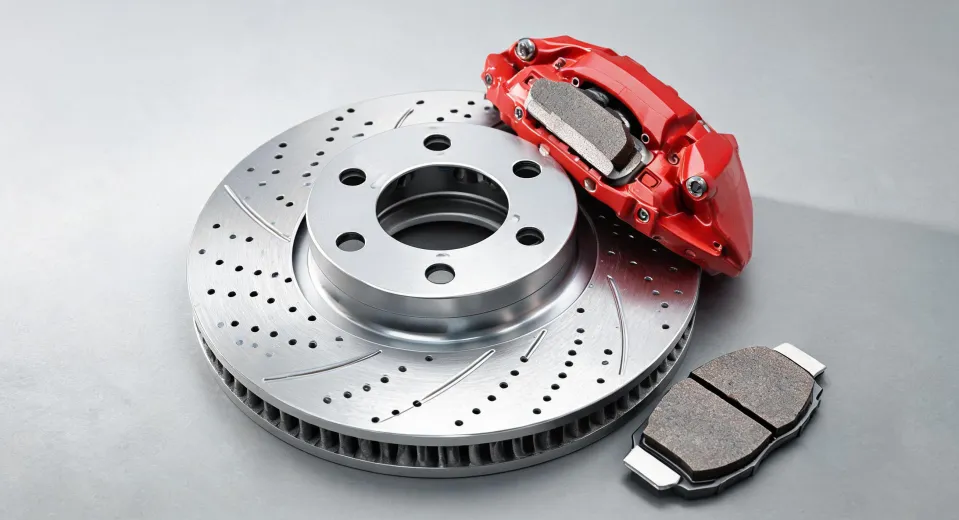
Here's a recent example. A client was sourcing brake rotors for a fleet of delivery vans. They'd been buying Centric 120 series rotors and Centric CTEK rotors — quality parts with consistent metallurgy and proper balancing. Then a new purchasing manager decided to test a cheaper alternative. Same dimensions on paper. Same lug pattern. About $200 less per vehicle set. Sounded like a win, right?
Did I believe the specs were truly identical? Not for a second. But the decision wasn't mine to make, so we waited.
The first complaints showed up within two months. Brake pulsation. Premature wear. Two warranty claims in the first six weeks. When we finally ran the full accounting, the $200 per-set savings had turned into $1,300 in replacement labor, $900 in lost vehicle uptime, and a customer satisfaction problem that doesn't show up on any invoice.
That, right there, is the whole argument in one story.
The Differential: Complexity You Can't See
Let's talk about the differential in a car for a second. It's an assembly of gears, bearings, and housings that has to handle massive torque while maintaining precise tolerances under extreme heat and load. A spec sheet tells you the gear ratio is 3.73:1 and the housing is cast iron. It doesn't tell you about gear tooth surface finish, heat-treatment consistency, or the runout tolerance on the bearing journals.
Those invisible qualities are the difference between a differential that hums along for 150,000 miles and one that starts whining at 30,000. And you can't see any of them in a price comparison.
The Head Gasket Math Nobody Does
People search "how much does a blown head gasket cost" and get the standard answer: roughly $1,500 to $3,000 for most vehicles, depending on the engine and labor rates (source: industry repair cost surveys, 2024). But here's the thing — the head gasket itself is pretty cheap. Maybe $50 to $200 for a quality one. The labor is where the money goes.
So what happens when someone buys a bargain gasket to save $40? If it fails, the labor cost is the same. The shop time is the same. The customer frustration is the same. You just paid the most expensive labor rate in the business twice because you tried to save $40 on the one part holding the engine together. That's not saving. That's expensive optimism.
When "Standard" Meant Two Different Things
Here's a mistake that cost a client weeks — and it wasn't even a cheap part. In March 2024, 36 hours before a deadline, we received a shipment of stamped brackets that failed inspection. Our engineering team had agreed on a "standard tolerance" with the supplier. To us, that meant ±0.15 mm. To them, it meant ±0.5 mm. We were using the same words but meaning completely different things.
The shipment got rejected, the line went idle, and the expedite fees to recover the schedule cost more than the entire bracket order. All because nobody verified a simple assumption.
If you've ever had a delivery fail at the final step like that, you know the sinking feeling. It's not about price. It's about whether the supplier actually understands what you need.
Downtime Is the Real Price
Everything I've described gets amplified when the part goes into critical equipment. Take the fuel pump Caterpillar specifies for its mining haul trucks. The pump itself might cost a few hundred dollars. But when it fails, you've got a $2 million machine sitting still, and every hour of downtime has a number attached to it.
In that world, nobody asks "what's the cheapest pump?" They ask "how fast can you get me a reliable one?" And that's the right question to ask — whether the part costs $40 or $4,000.
What If Your Budget Is Tight?
At this point you might be thinking, "Easy for you to say. My boss wants the lowest number on the purchase order." I get it. Budgets are real, and nobody wants to be the person who overpays.
But here's what I've learned from working with the best procurement teams: they don't measure cost per part. They measure cost per mile, cost per hour of uptime, or cost per completed repair. That's a no-brainer shift once you've seen the numbers side by side. The question isn't "what's quoted?" The question is "what does this part cost over its lifetime?" Those are very different numbers.
Bottom Line
So here's where I land. The cheapest quote is the most expensive choice when it fails. And in automotive parts, failure means downtime, warranty claims, and double labor. That's the cost nobody puts on the compare chart.
Does that mean you should ignore price and buy premium everything? No. It means the lowest number on a quote isn't a strategy. It's just a number. The real strategy is evaluating total value — consistency, tolerance control, response time, and track record. Take it from someone who's spent ten years cleaning up after "great deals." The best deal is the one that doesn't fail on your watch.